
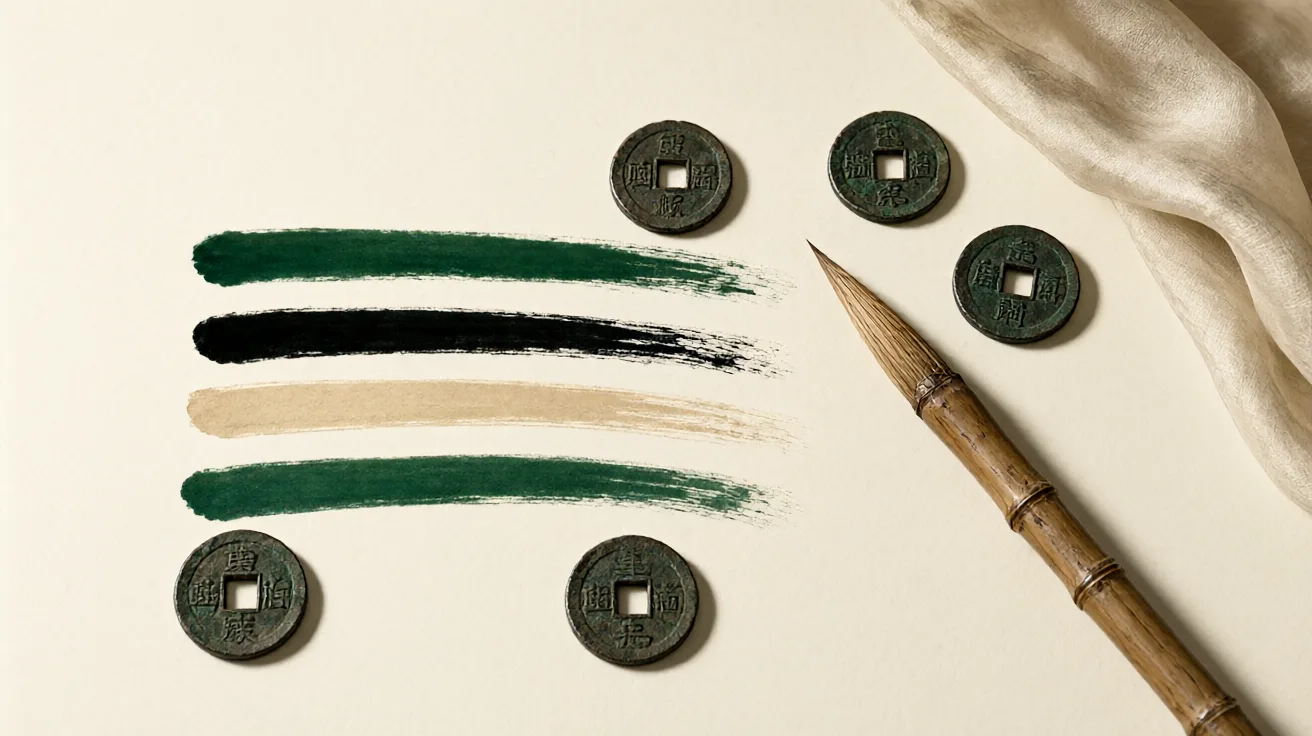
A hexagram consists of six lines
The I Ching constructs hexagrams from yin and yang lines, with six positions arranged from bottom to top. The 64 hexagrams are the nomenclature and textual system for these combinations, not 64 fixed predictions of fortune.
Casting yields the primary hexagram; when moving lines appear, there are corresponding changed hexagrams. Traditional interpretation references the hexagram statements, line statements, the position of moving lines, and the specific question asked.
Why the Question Matters
The same hexagram can be used to discuss relationships, career, choices, or self-reflection. Without a clear question, interpretation tends to devolve into arbitrary association.
Open-ended questions are generally more suitable than forcing a binary yes-or-no answer. For example, "What is the most important thing I need to be mindful of in this collaboration?" yields more meaningful discussion than "Will the other person definitely contact me tomorrow?"

Hexagrams Are Not Commands
Traditional divination provides a language for observation and reflection. It should not replace medical, legal, financial, safety, or major life decisions.
If an interpretation brings about fear, dependency, or repeated casting, one should pause. A sound practice is to record the question, the hexagram, and one's own judgment, then revisit them after a period of time.
How to Use in Apps and Web Browsers
The web version allows inputting the results of six coin tosses or using a random casting process for learning. The app can maintain complete records, facilitating later review of the original questions and understandings.
The basic level focuses on recognizing the primary hexagram, moving lines, and changed hexagrams; detailed explanations of the 64 hexagrams and specific line statements will follow later.
Frequently Asked Questions
Can I Ching divination predict definitive outcomes?
It should not be treated as definitive prediction. It is better suited as a traditional text and a tool for self-reflection.
Can I ask the same thing repeatedly every day?
Not recommended. Repeated casting can cause interpretations to conflict with one another and may weaken the clarity of the initial inquiry.
Go Deeper
This is the Fundamentals introduction. Future updates will add etymologies of key terms, differences among schools of thought, verifiable reference methods, and common misconceptions—following professional publishing standards.