
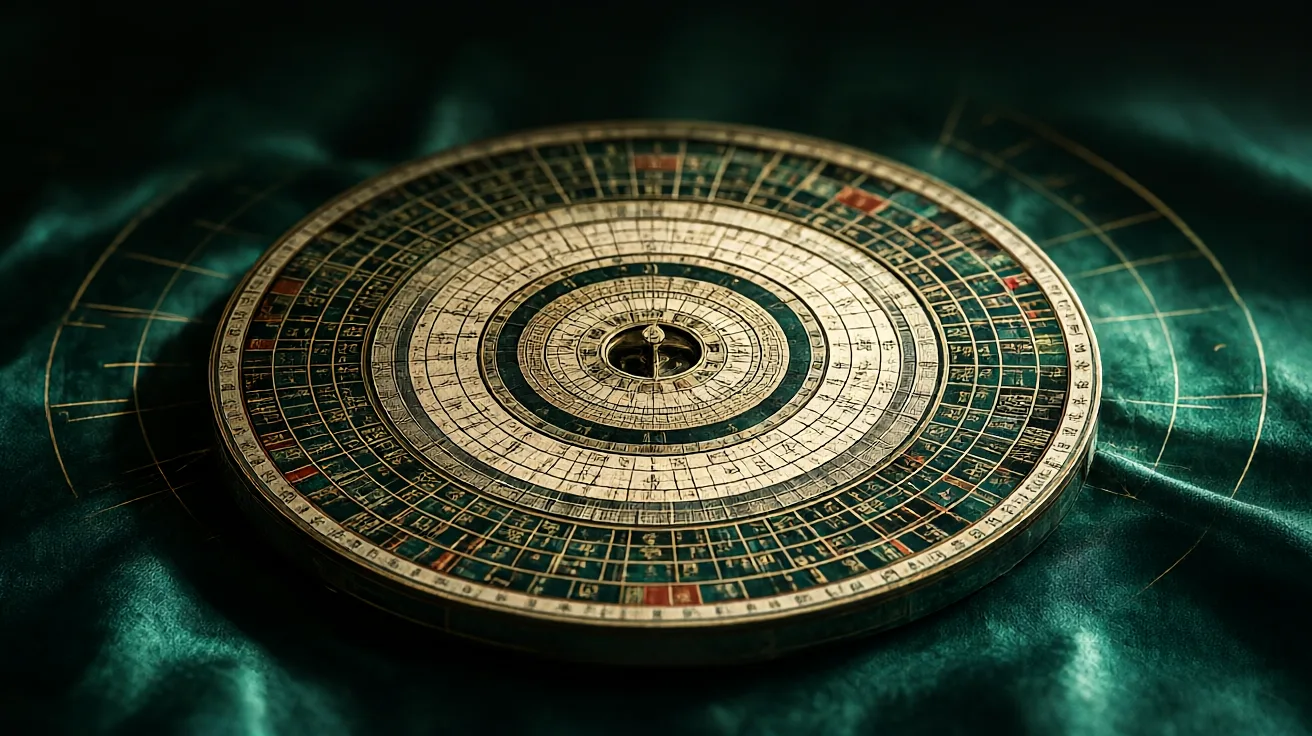
Basic Composition and Logic of the Twenty-Four Mountains
The Twenty-Four Mountains constitute the core orientation system in traditional Chinese Luo Pan (Luopan) practice. They divide the 360-degree circle into 24 sectors, each spanning 15 degrees. This division is not arbitrary but stems from the ancient need for a refined cognition of the spatial dimensions of heaven and earth. The system comprises the eight Heavenly Stems, the four Bagua corners, and the twelve Earthly Branches. It is important to note that in traditional terminology, the 'eight stems' refer to the four cardinal directions (East, West, South, North) combined with the four intercardinal directions (Southeast, Southwest, Northeast, Northwest), which correspond to the Bagua trigrams Qian, Kun, Gen, and Xun. Specific details require reference to the subsequent elaboration.
To clarify the composition: the Twenty-Four Mountains are formed by combining specific elements from the Heavenly Stems, Earthly Branches, and the Eight Trigrams. The sequence includes: eight Heavenly Stems (Jia, Yi, Bing, Ding, Geng, Xin, Ren, Gui), eight Earthly Branches (Zi, Chou, Yin, Mao, Chen, Si, Wu, Wei, Shen, You, Xu, Hai — though only specific positions are used in the standard sequence, effectively 8 branch positions in the 24-cycle? No, the standard sequence uses all 12 branches and 8 stems plus 4 trigrams. Let us recalibrate: 4 cardinal directions are replaced by specific stems/branches, 4 intercardinal directions are represented by the Bagua trigrams (Gen, Xun, Kun, Qian). The correct composition is: 4 cardinal directions + 4 intercardinal directions + 8 heavenly stems + 8 earthly branches? This is a common misconception. The actual traditional count is: 8 Heavenly Stems + 8 Earthly Branches + 4 Bagua Trigrams = 24. Wait, the 12 Earthly Branches are not all used as distinct 'mountains' in the same way. The standard sequence is: Ren, Zi, Gui, Chou, Gen, Yin, Jia, Mao, Yi, Chen, Xun, Si, Bing, Wu, Ding, Wei, Kun, Shen, Geng, You, Xin, Xu, Qian, Hai. Tally: 8 Heavenly Stems (Ren, Gui, Jia, Yi, Bing, Ding, Geng, Xin); 8 Earthly Branches (Zi, Chou, Yin, Mao, Chen, Si, Wu, Wei, Shen, You, Xu, Hai — actually 12 branches are in the 24 list? No, the list has 24 items. 8 Stems + 4 Trigrams + 12 Branches = 24. Yes. The 4 cardinal directions are implicitly represented by the grouping of these stems and branches (e.g., Ren-Zi-Gui centers on North). Therefore, the 24 Mountains = 8 Stems + 12 Branches + 4 Trigrams = 24. This is the most accurate explanation of the composition.
Analysis of the Multi-Layer Concentric Circular Structure of the Luo Pan
The traditional Luo Pan (Luopan) is a complex concentric circular tool. Its structure, from the innermost layer outward, typically contains multiple rings with distinct functions. The innermost layer is usually the 'Heavenly Pool' (Tian Chi), which houses the magnetic needle for determining magnetic north. Outside this is the 'Twenty-Four Mountains' layer, used to indicate basic orientations. Further out are layers such as the 'Pre-Heaven Bagua' and 'Post-Heaven Bagua', used for deriving hexagram imagery. Outermost layers may include the 'Sixty-Four Hexagrams', 'One Hundred and Twenty Dragons', and 'Zhou Zi Quan Shu'. Each layer carries different dimensions of information, such as orientation, hexagrams, degrees, and Na Jia Five Elements. These layers are superimposed to form a three-dimensional system for orientation analysis.
The key to understanding 'layering' lies in recognizing that information from different layers cannot be intermixed. For example, the Twenty-Four Mountains layer primarily addresses 'which orientation am I facing?', while the Bagua layer addresses 'what hexagram does this orientation belong to, and what attributes does it possess?'. Different schools (such as Xuan Kong, Ba Zhai, San He, and San Gua) have radically different emphases and usage methods for various Luo Pan layers. Xuan Kong studies emphasize the combination of Nine Palace Flying Stars with the Twenty-Four Mountains. Ba Zhai studies focus on the relationship between Bagua You Nian (Eating and Drinking) and sitting orientations. San He studies concern the yin and yang attributes of mountain and water dragons relative to the Twenty-Four Mountains. Therefore, one must not assume that any specific Luo Pan layer has a universal, absolute auspicious or inauspicious meaning; interpretation must be done within the theoretical framework of a specific school.
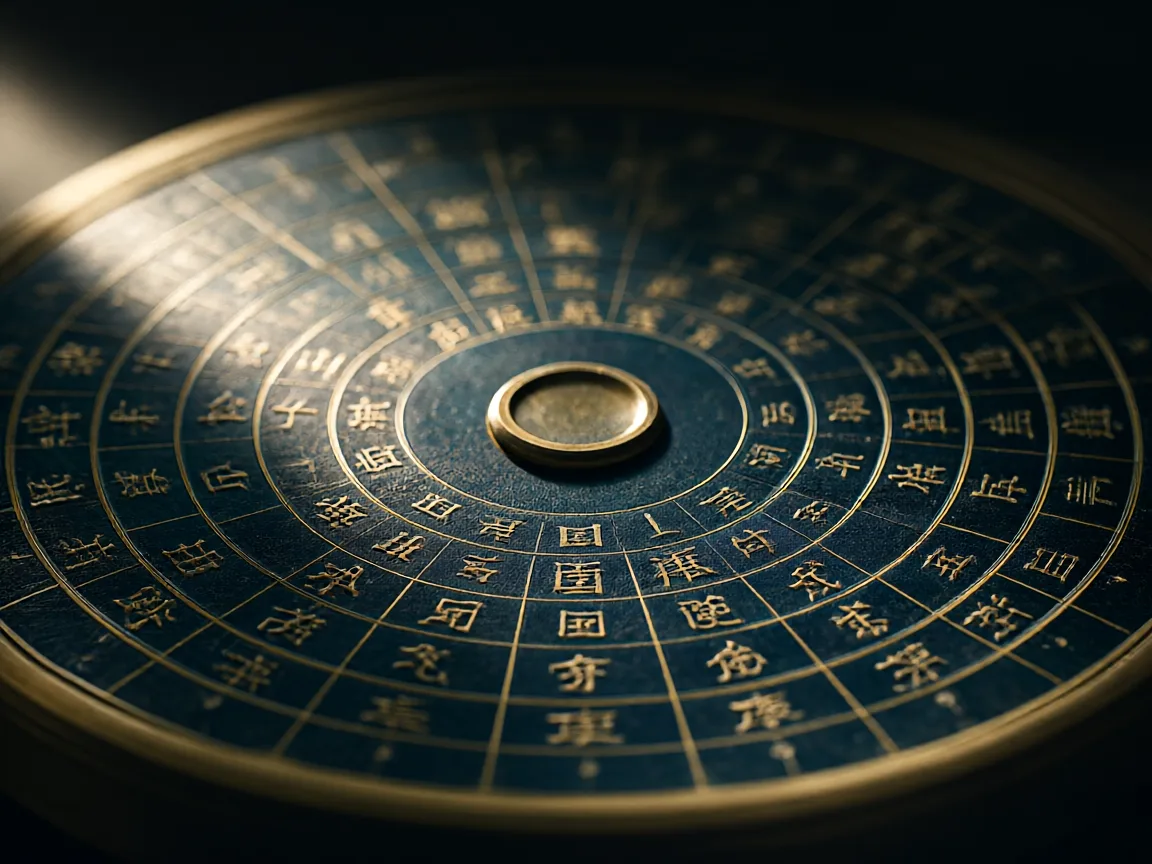
Application Differences of Various Schools in Luo Pan Layers
In Feng Shui practice, different schools utilize Luo Pan layers in significantly different ways. Take the San He school, for example. It primarily judges the auspiciousness of incoming and outgoing water based on the yin and yang attributes of the Twenty-Four Mountains (e.g., Yang dragon and Yin water, Yin dragon and Yang water), emphasizing the principle that 'mountains govern descendants, and water governs wealth.' In contrast, the Xuan Kong Flying Star school focuses more on the 'Mountain and Facing' combinations of Flying Stars in specific periods, using the Twenty-Four Mountains as a baseline for locating orientations and combining annual, monthly, daily, and hourly Flying Stars for comprehensive inference. The Ba Zhai school primarily determines the east or west four dwellings and east or west four life cycles based on the Bagua attribute of the 'Sitting Mountain' (e.g., sitting Mao belongs to Zhen hexagram) and the homeowner's life hexagram, thereby determining the auspiciousness of indoor orientations.
These differences indicate that the same 'Mao Mountain You Facing' orientation may yield completely different auspicious or inauspicious judgments in different schools. Therefore, when using the Luo Pan or related tools, learners must first clarify the theoretical system being adopted. Applying San He school 'water method' conclusions directly to Xuan Kong school 'flying star' judgments will easily lead to logical confusion and biased conclusions. The Luo Pan itself is a neutral tool; its value lies in providing an orientation baseline, while specific interpretation depends on the underlying theoretical framework.
Precise Division Method for the Twenty-Four Mountain Orientations
The Twenty-Four Mountains divide the 360 degrees equally into 24 sectors, each 15 degrees. In specific division, true North 360 degrees (or 0 degrees) is typically covered by the 'Ren', 'Zi', and 'Gui' mountains, with the 'Zi' mountain in the center corresponding to magnetic north. The 'Ren' mountain is 15 degrees to the west of the Zi mountain (345°-360°), and the 'Gui' mountain is 15 degrees to the east of the Zi mountain (0°-15°). Similarly, true East 90 degrees is covered by the 'Jia', 'Mao', and 'Yi' mountains, with the 'Mao' mountain in the center (75°-90°). 'Jia' is 60-75°, 'Mao' is 75-90°, and 'Yi' is 90-105°. Yes, the 'Mao' mountain includes the 90-degree true East line. This division ensures that each orientation has a clear 'center' mountain (such as Zi, Wu, Mao, You, Chen, Xu, Chou, Wei) and 'adjacent' mountains (such as Ren, Gui, Jia, Yi, etc.).
In practical application, Feng Shui practitioners often use the 'center' mountain as the representative of the sitting orientation. For example, 'Zi Mountain Wu Facing' refers to a sitting line located near the center line of the 'Zi' mountain (352.5°-2.5°) and 'Wu' mountain (172.5°-187.5°). If the sitting line leans towards the 'Ren' or 'Gui' mountain, it is called 'Zi with Ren' or 'Zi with Gui', and its auspicious or inauspicious judgment may be completely different because adjacent orientations involve the generative and controlling relationships of the Five Elements between different mountains. Therefore, minor deviations within the 15-degree range significantly impact analysis results, which is why the Luo Pan requires high-precision magnetic needles and scale lines.
How to View This in MysticFate
The Luo Pan feature in the MysticFate application is designed to provide users with an intuitive visual experience of the Twenty-Four Mountains orientations. When you open the Luo Pan interface, the central magnetic needle points to magnetic north, and the surrounding concentric rings clearly mark the names of the Twenty-Four Mountains, such as 'Ren Zi Gui'. The application automatically calculates the corresponding 'mountain' for the current orientation in real-time based on device location and orientation sensors. For example, when you face true East, the Luo Pan will highlight the 'Mao' mountain and may display the 'Jia' and 'Yi' mountains as adjacent orientations. This function helps users quickly understand 'which Twenty-Four Mountains orientation I am currently facing', serving as a convenient digital tool for the traditional Luo Pan.
The application interface also allows users to switch between different layer views, such as overlaying the 'Post-Heaven Bagua' or 'Nine Palace Flying Stars', so users can intuitively see the correspondence between orientations and hexagrams. For example, when the Luo Pan points to the 'Xun' mountain, users can switch to the Bagua layer to see the 'Xun' hexagram icon. This layered display function helps users understand the concept of the 'multi-layer structure' of the Luo Pan, where different layers provide information in different dimensions. However, the application primarily provides orientation labeling and basic layer visualization; it does not directly output auspicious or inauspicious conclusions. Users must combine specific school theories to interpret the results themselves.
Common Misconceptions and Boundaries
Regarding the Twenty-Four Mountains and Luo Pan usage, there are several common misconceptions. First, the belief that a 'certain mountain' necessarily corresponds to a fixed auspicious or inauspicious outcome. In reality, the Twenty-Four Mountains are orientation labels; auspiciousness depends on the Five Elements generation and control, Flying Star combinations, and Qi theory deductions for that mountain in the current time and space context. For example, the 'Zi' mountain is 'prosperous' in certain Xuan Kong periods but 'retiring' in others; therefore, there is no absolute statement that 'Zi Mountain is always auspicious.' Second, confusing magnetic north with true north. Due to magnetic declination, uncorrected magnetic north orientations can lead to deviations in locating the 24 mountains, affecting analysis accuracy. Users must clearly distinguish between magnetic and true north and perform corrections when necessary.
Third, the assumption that Luo Pan layers can be arbitrarily superimposed for interpretation. For example, directly mixing 'Pre-Heaven Bagua' attributes with 'Post-Heaven Bagua' Flying Star results leads to logical conflicts. Each layer corresponds to a different theoretical system and requires consistency within that system. Fourth, equating orientation auspiciousness with event prediction. The Twenty-Four Mountains locate spatial orientation attributes and cannot directly predict that 'living in this orientation guarantees wealth' or 'guarantees health.' Feng Shui is the study of environmental coordination, emphasizing harmony between humans and the environment, rather than deterministic event prediction. The 'auspicious/inauspicious' markers displayed in the application interface (if any) are only references based on specific school rules and do not constitute absolute guarantees.
Philosophical Connotations of the Twenty-Four Mountains in Traditional Culture
The Twenty-Four Mountains are not merely orientation tools; they contain profound traditional cultural philosophy. Their composition integrates heavenly stems, earthly branches, and Bagua orientations, reflecting the cosmological view of 'Harmony between Heaven and Humanity.' Heavenly stems represent celestial changes, earthly branches represent terrestrial rhythms, and the Bagua represents spatial attributes. Their integration in the Twenty-Four Mountains symbolizes the unity of time and space. For example, the 'Zi' mountain corresponds to the Winter Solstice, and the 'Wu' mountain corresponds to the Summer Solstice, reflecting the natural laws of yin and yang dynamics. This design integrates astronomy, geography, and calendrics, reflecting the ancients' deep understanding of cosmic order.
On a philosophical level, the 15-degree division of the Twenty-Four Mountains reflects the concept of 'Middle Way'. Each mountain occupies 15 degrees, having clear boundaries while leaving space for adjacent orientations, avoiding absolutism. For example, 'Zi with Gui' indicates the transitional zone between true North (Zi) and Northeast (Gui), embodying the gradual nature of transformation. This design encourages practitioners to avoid rigid thinking and to pay attention to subtle changes in orientation. Additionally, the combination of the Twenty-Four Mountains with the Nine Palace Flying Stars embodies the idea of 'time-space interaction', where orientation auspiciousness varies with time (periods, years, months, days, hours) rather than being static and fixed.
Frequently Asked Questions
What is the order of the Twenty-Four Mountains?
The sequence of the Twenty-Four Mountains according to the Luo Pan is: Ren, Zi, Gui, Chou, Gen, Yin, Jia, Mao, Yi, Chen, Xun, Si, Bing, Wu, Ding, Wei, Kun, Shen, Geng, You, Xin, Xu, Qian, Hai. Each mountain is 15 degrees. The Zi mountain is centered at magnetic North, the Wu mountain at magnetic South, the Mao mountain at magnetic East, and the You mountain at magnetic West.
Can the MysticFate Luo Pan directly tell me which orientation is most auspicious?
No. The MysticFate Luo Pan feature primarily displays Twenty-Four Mountains orientation labels and layer visualization, providing orientation references. Auspicious or inauspicious judgments require combining specific schools (such as Xuan Kong or Ba Zhai), time factors (periods, years, months), and personal destiny. The application does not output absolute auspicious or inauspicious conclusions; it serves only as a tool for orientation identification and conceptual education.
What are the 'layers' of the Luo Pan? Can different layers be mixed?
Luo Pan layers refer to the concentric circular structure, which from inner to outer includes the Heavenly Pool, Twenty-Four Mountains, Bagua, Flying Stars, and other layers. Each layer provides different information (orientation, hexagrams, degrees, etc.). Different layers correspond to different theoretical systems (e.g., Xuan Kong uses the Flying Star layer, Ba Zhai uses the Bagua layer) and cannot be mixed arbitrarily. For example, applying Xuan Kong Flying Star conclusions directly to San He water methods will lead to logical errors.
What is the difference between magnetic north and true north? Does the Luo Pan reading need correction?
Magnetic north is the direction of the magnetic pole indicated by the magnetic needle, while true north is the geographic North Pole. There is a magnetic declination between the two, which varies with geographic location and time. Traditional Luo Pans usually point to magnetic north. Rigorous Feng Shui practice requires correcting the magnetic north reading by adding or subtracting the local magnetic declination to convert it to true north, ensuring accurate location of the Twenty-Four Mountains. The MysticFate application may provide magnetic declination correction options, which users should adjust according to their location.
Go Deeper
This is the Fundamentals introduction. Future updates will add etymologies of key terms, differences among schools of thought, verifiable reference methods, and common misconceptions—following professional publishing standards.