

The Three Zones: Traditional Metaphors for Life Stages
In the traditional system of physiognomy, the 'Three Zones' constitute a core model that divides the face longitudinally into three distinct sections. Specifically, the area from the hairline to the brow ridge is termed the 'Upper Zone,' the area from the brow ridge to the base of the nose is the 'Middle Zone,' and the area from the base of the nose to the tip of the chin is the 'Lower Zone.' These three segments correspond respectively to the early, middle, and late stages of life. Traditional beliefs approximate the early stage as ages fifteen to thirty, the middle stage as thirty-one to fifty, and the late stage as fifty-one and beyond.
When observing the face, the ancients did not merely measure lengths; instead, they used the proportional ratios of these three segments to metaphorically represent the fluctuations of one's fortune. If one segment is significantly shorter than the other two, traditional interpretations suggest that the corresponding life stage may face challenges or an uneven distribution of resources. Conversely, if the three segments are harmonious and balanced, this is viewed as a symbol of flowing vitality and coherence. This method of division reflects the ancients' unique perception of the correspondence between the dimension of time and spatial form, embodying the 'symbolic-numerical' thinking found in traditional culture. It aims to interpret the dynamic journey of life through static facial structures.
The Five Marks: A Symbolic System of the Five Peaks
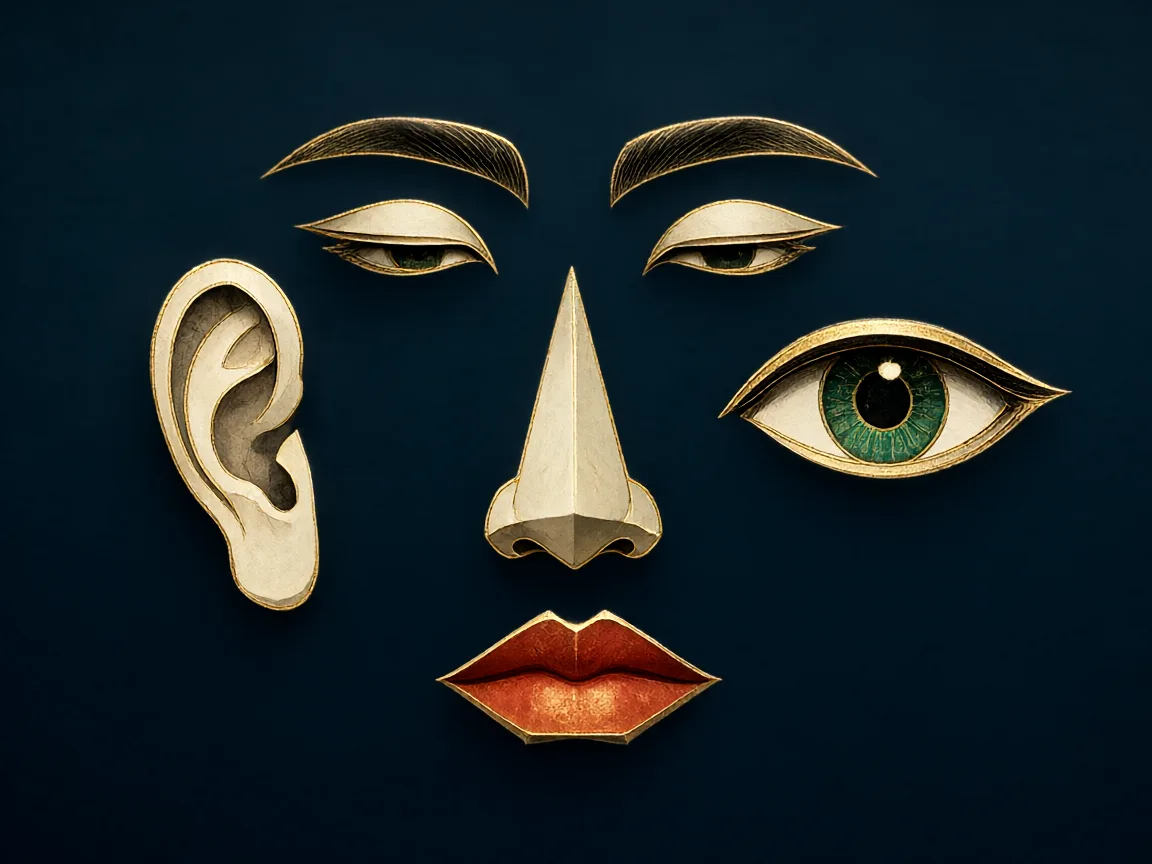
Unlike the 'Three Zones,' which focus on the dimension of time, the 'Five Marks' emphasize the functional symbolism of facial organs. In traditional physiognomy, the 'Five Marks' refer to the ears, eyebrows, nose, mouth, and eyes, collectively known as the 'Five Peaks.' The ears govern hearing and information intake, corresponding to one's foundation and childhood; the eyebrows represent brotherly affection and emotional management; the nose signifies the treasury of wealth and the self-centered aspect; the mouth governs fortune, salary, and verbal expression; and the eyes reflect the nature of the heart and wisdom.
Within this system, each of the five marks has specific functional attributions. For instance, the nose is considered the center of the face, symbolizing the capacity of the 'treasury of wealth'; therefore, tradition holds that a straight nasal bridge and a fleshy nose tip represent stable financial fortune. The eyes, as the windows to the soul, are often interpreted such that the brightness or dullness of the gaze indicates the purity or complexity of one's character. These interpretations are not based on anatomy or physiology, but rather stem from ancient society's abstract generalizations of interpersonal interactions, resource acquisition, and mental states, forming a complete symbolic language used to categorize and evaluate individual traits on a cultural level in the absence of modern medical knowledge.
Proportional Harmony: The Cultural Logic of Empirical Induction
The core logic behind traditional physiognomy's emphasis on 'proportion' lies in the concept of 'harmony.' The ancients did not pursue the extreme perfection of a single organ, but rather sought an overall balance where the lengths of the three zones were equal and the placement of the five marks was appropriate. This reverence for 'evenness and fullness' is essentially a cultural model derived from empirical induction. In agricultural societies, a full facial appearance was often associated with adequate nutrition and good health, gradually evolving into an aesthetic standard and further being granted the authority to interpret auspiciousness or inauspiciousness in destiny.
It must be clearly stated that the viewpoint that 'proportional harmony represents coherent vitality' is a combination of subjective aesthetics and cultural experience, not a scientific law. Significant differences exist among different schools and regions regarding views on facial proportions; for example, some schools prioritize the length of the Upper Zone, while others emphasize the width of the Middle Zone. Therefore, the 'emphasis on proportion' reflects the pursuit of 'perfection' and 'order' by people during specific historical periods, serving as a narrative tool for explaining the world rather than an objective standard for measuring reality. It provides a framework for observing facial features but should not be misunderstood as an absolute law revealing truth.
Perspective in MysticFate
In the physiognomy module of the MysticFate application, users can view diagrams of the 'Three Zones' and 'Five Marks' generated based on traditional theories. These diagrams use lines and zone divisions to intuitively display the visual structure of the segmented face, accompanied by corresponding cultural explanatory text. For example, when a specific proportional segment is identified, the system displays an explanation of its symbolic meaning in a traditional context, such as 'a high Upper Zone traditionally implies early-life fortune.'
All content visible to users in this section is strictly limited to the display of traditional cultural knowledge. The interface design aims to help users understand the definitions and traditional interpretations of the 'Three Zones' and 'Five Marks,' serving a role in cultural popularization. The system does not provide definitive conclusions such as 'you will become wealthy in the future' or 'you are introverted.' All explanatory text is labeled as 'traditional views' or 'cultural references,' intended to guide users to view this content with an attitude of appreciation and understanding of traditional folklore, rather than using it as a basis for personal decision-making.
Common Misconceptions and Boundaries
A common misconception among users is to directly link physiognomic features to specific real-world outcomes. For instance, believing that a short nasal bridge represents 'poverty' or a fierce gaze indicates 'evil intentions.' This is a serious cognitive bias. Traditional physiognomy itself has many schools with differing theories and often exhibits historical limitations; it cannot serve as a scientific basis for determining personal wealth, health, longevity, or moral character.
When using the physiognomy feature of MysticFate, its boundaries must be clearly remembered: it does not have medical diagnostic functions and cannot replace a doctor's judgment of health status; it does not have legal or investment consulting functions and cannot serve as a basis for financial planning or legal decisions; nor does it have psychological diagnostic functions for assessing personality disorders or mental states. Physiognomy is merely a cultural phenomenon; excessive superstition or instrumentalization of it violates scientific spirit and departs from the original intent of traditional cultural education.
Cultural Inheritance from a Rational Perspective
Viewed from a rational perspective, the value of physiognomy as a traditional culture lies more in the sociological and anthropological realms than in divination. It records the observations and reflections of the ancients regarding human structure, social roles, and survival environments. Understanding the 'Three Zones' and 'Five Marks' is essentially understanding an ancient visual language that reflects the ancients' simple and unadorned imagination regarding the relationship between order, harmony, and fate.
In modern society, we advocate viewing such traditional culture with open and critical eyes. Learning physiognomy knowledge should be approached like learning historical stories or folk arts: extracting the cultural core while discarding the dross of superstition. Through platforms like MysticFate, users can systematically understand the status of 'proportion' in traditional aesthetics while clearly distinguishing the boundary between 'cultural metaphor' and 'factual judgment.' This ability to make distinctions is one of the important missions of traditional cultural education in contemporary times, helping users establish a healthy cognitive framework.
Summary: The Boundary Between Aesthetics and Experience
In summary, traditional physiognomy emphasizes 'proportion' because in the ancients' experiential model, evenness represented balance, balance represented harmony, and harmony was regarded as an auspicious sign. However, this logical chain is built on subjective induction and cultural symbolism, lacking the rigor and falsifiability of natural science. The physiognomy feature of MysticFate provides a system for displaying these traditional symbols and their interpretations, rather than a tool for predicting the future.
Users should maintain a clear cognition when using this feature: facial features are influenced by various factors such as genetics, development, and environment; their changes are dynamic and complex, and cannot be locked into a fate through static proportional measurements. Viewing physiognomy as a window to understand traditional culture and a way to appreciate classical aesthetics is far more appropriate than viewing it as a judgment of destiny. Only by maintaining the boundary between 'cultural display' and 'scientific fact' can we truly achieve a positive interaction between traditional wisdom and modern rationality, avoiding the extremes of blind worship or one-sided denial.
Frequently Asked Questions
Can MysticFate's physiognomy feature accurately predict my future wealth?
No. This feature only displays cultural concepts and symbolic interpretations from traditional physiognomy, belonging to the realm of traditional cultural education. It does not possess scientific predictive capabilities; all results are for reference only and must not be used as a basis for investment decisions.
What are the 'Three Zones' in physiognomy? Which specific areas do they refer to?
The 'Three Zones' refer to dividing the face longitudinally into three sections: the Upper Zone (hairline to eyebrows), the Middle Zone (eyebrows to base of the nose), and the Lower Zone (base of the nose to chin). Traditionally, they correspond respectively to the early, middle, and late stages of life, emphasizing the proportional harmony of the three sections.
What do the five marks represent in physiognomy? Does a short nose necessarily mean bad financial luck?
The five marks (ears, eyebrows, nose, mouth, eyes) correspond to different dimensions of life in tradition, such as the nose governing the treasury of wealth. However, the idea that 'a short nose represents bad financial luck' is merely a subjective metaphor within traditional schools, not a fact. There is no inevitable causal relationship between facial features and actual wealth; one should not be superstitious about this claim.
Do the divisions of the Three Zones differ between young people and the elderly?
Traditionally, it is believed that the fullness of the Three Zones varies with age and state, but the 'Three Zones' themselves are a static description of the longitudinal proportions of the face and are not re-divided based on age. Different schools also vary in their aesthetic standards for 'fullness'; these should be understood as cultural experiential models rather than objective criteria.
Go Deeper
This is the Fundamentals introduction. Future updates will add etymologies of key terms, differences among schools of thought, verifiable reference methods, and common misconceptions—following professional publishing standards.