
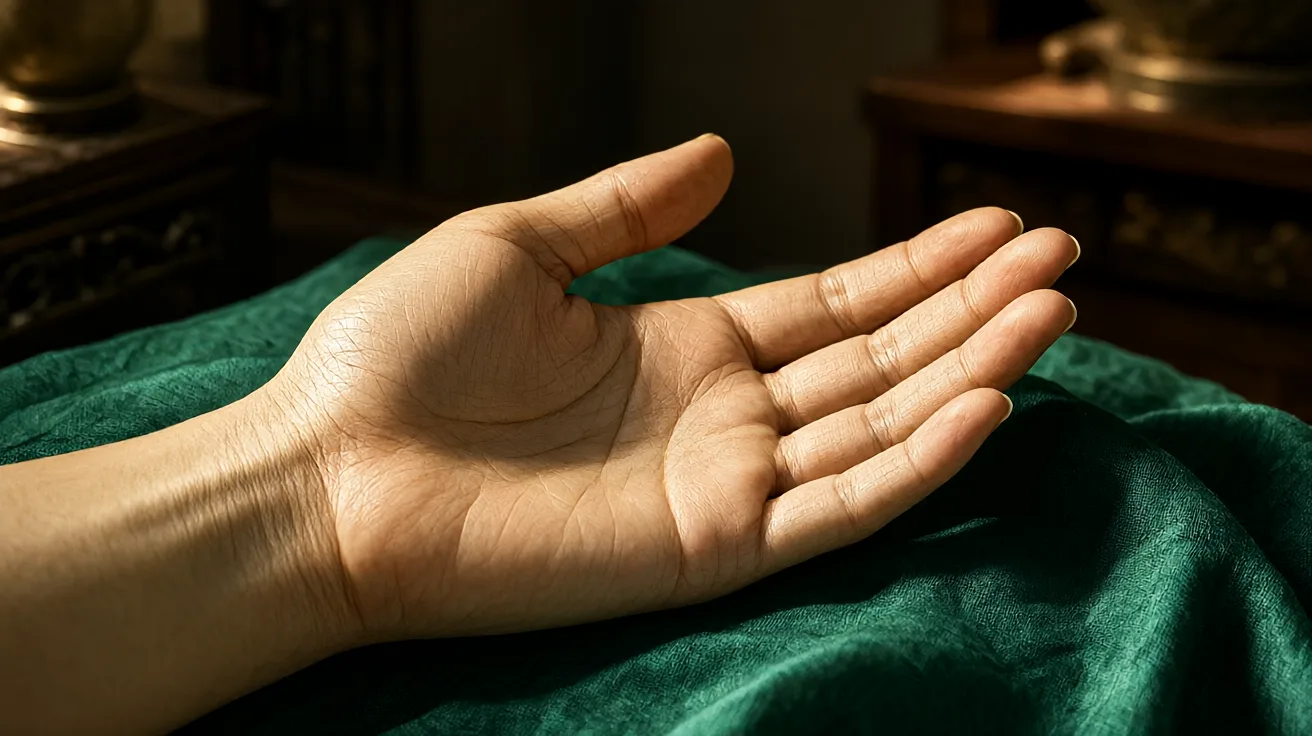
Introduction: The Necessity of a Fixed Reading Order
In the traditional system of palm reading, observation is not random or isolated but follows a logical hierarchy from the macro to the micro and from the whole to the parts. This sequence aims to establish a holistic grasp of an individual's life state, preventing fragmented interpretations of trivial details and ensuring that the analysis maintains a coherent narrative.
A fixed reading order reflects the systematic thinking inherent in traditional empirical induction. It guides the observer to first establish a broad framework before filling in the details, allowing complex palm markings to be presented in an orderly manner rather than as a chaotic accumulation of data. This approach aligns with the cognitive psychological principle of moving from general to specific.
Adhering to this standard process helps reduce biases caused by subjective assumptions, bringing interpretations closer to the essence of traditional palmistry as a cultural model. It is not merely a technical operation but a cognitive framework that assists in distinguishing primary from secondary relationships amidst intricate palm details.
Level One: Palm Shape Sets the Overall Tone
Palm shape is the first step in reading the hand. Traditionally, hand types are often categorized into five elements: Metal, Wood, Water, Fire, and Earth, or classified by length-to-width ratios into shapes such as square, long, round, and square-long. These classifications are not rigid labels but correspond to different temperamental inclinations and behavioral styles.
For example, an Earth hand is typically thick and steady, a Wood hand is slender and upright, and a Water hand is flexible and versatile. The palm shape determines the foundational character baseline and provides contextual reference for subsequent analysis of mountains and major lines, serving as the cornerstone of the entire reading process and influencing the interpretation of other features.
By observing the palm’s length-to-width ratio, finger thickness, and joint structure, one can preliminarily determine whether an individual’s temperamental baseline leans toward rational pragmatism or emotional romanticism. This level of judgment establishes the macro-context for more detailed line analysis, ensuring that the interpretation does not deviate from the overall temperament.

Level Two: Palmar Mountains Reflect Domain Tendencies
Palmar mountains are the raised areas on the palm. Traditional palmistry posits that different mountains correspond to specific body parts or life domains. For instance, the Mount of Venus represents vitality and emotion, the Mount of Jupiter is associated with power and ambition, the Mount of Saturn relates to caution and introspection, and the Mount of Solar corresponds to reputation.
Observing the height and fullness of these mountains can assist in assessing an individual’s tendencies in specific domains. This level lies between palm shape and major lines, helping to understand the distribution of energy in particular life areas and reflecting subconscious preferences and focal points.
When a specific palmar mountain is exceptionally full or flat, it often implies the relative importance of that domain in the individual’s life. For example, a full Mount of Venus suggests abundant energy and approachability, while a high Mount of Jupiter may indicate strong leadership and enterprising spirit.
Level Three: Major Lines Outline Life Trajectories
Major lines include the Life Line, Head Line, and Heart Line, which are the most distinct and widely discussed lines in palmistry. The Life Line reflects the strength of vitality and constitutional characteristics; the Head Line embodies thinking patterns and cognitive preferences; the Heart Line is associated with emotional traits and interpersonal dynamics.
Although the Fate Line is not clearly visible in every individual, it is frequently used as a reference indicator for assessing career tendencies and life goals. These major lines illustrate the general direction of life and its stage-specific characteristics, revealing the individual’s potential states and psychological inclinations at different points in time.
When reading these lines, one must integrate them with the preceding levels of palm shape and palmar mountains, avoiding isolated interpretation of any single line. Instead, their significance should be understood within the context of the entire hand. For example, a short Head Line in a slender Wood hand may represent acute intuition, whereas in a square Earth hand, it might symbolize pragmatic decisiveness.
How to Interpret This in MysticFate
In the palmistry feature of MysticFate, the system displays analytical results according to the aforementioned hierarchy. It first presents the overall palm shape assessment, then indicates the status of the primary palmar mountains, and finally analyzes the morphology and trajectory of the three major lines, forming a progressively layered logical chain.
Users can view textual descriptions and graphical annotations for each level to understand their meanings within the traditional cultural model. This visual presentation aims to lower the barrier to comprehension, allowing users to intuitively perceive the logical connection between macro-level palm shapes and micro-level lines, thereby enhancing the reading experience.
The function is designed to provide a cultural perspective for reference, helping users understand their own temperamental tendencies and behavioral patterns, rather than offering deterministic predictions. Through structured output, the system encourages users to examine themselves with an open mind, transforming the traditional model into a tool for self-reflection.
Common Misconceptions and Boundaries
It must be clear that palmistry is a traditional cultural model; its conclusions are probabilistic and indicative, not medical diagnoses, determinations of lifespan, or fixed destinies. One cannot use palm lines to assert absolute facts regarding disease, longevity, or marital success. Rational boundaries must be maintained.
Different schools of thought offer varying interpretations of palmistry, and palm lines change dynamically with environmental factors and health conditions. Treating it as a reference dimension for self-awareness, while maintaining an open and rational attitude to avoid superstition or anxiety, is the correct usage boundary; one should not exaggerate its claims.
Do not equate a single palm feature directly with an inevitable outcome; rather, consider multiple factors comprehensively. In the modern context, palmistry serves more as a psychological projection and cultural symbol than a deterministic tool, requiring users to exercise critical thinking.
Conclusion: Viewing Traditional Wisdom with Rationality
The basic sequence of palm reading—from palm shape to palmar mountains to major lines—reflects the progressive logic of traditional wisdom. Mastering this order helps in understanding the structure and essence of the palmistry model more comprehensively and systematically, avoiding the confusion and misunderstanding arising from fragmented interpretations.
As a cultural reference, it serves as a mirror for self-examination rather than a key to controlling the future. By approaching traditional models rationally and integrating them with modern self-awareness, one can truly realize their educational significance and reference value, fostering personal growth.
While enjoying the appeal of traditional culture, we should maintain reverence and clarity, neither blindly believing in it nor entirely rejecting it. The value of palmistry lies in stimulating thought; by observing changes and characteristics in palm lines, it promotes deep insight and reflection on one’s character and emotional patterns.
Frequently Asked Questions
Can palmistry accurately predict my lifespan and health conditions?
No. Traditional palmistry is a cultural model; palm lines only reflect tendencies and do not constitute a medical diagnosis or a fixed lifespan. Please do not use palm lines to judge health. If you have concerns, please consult a professional healthcare provider.
Are the palm shape classifications limited to the five elements of Metal, Wood, Water, Fire, and Earth?
This is a common traditional classification, but some schools use morphological divisions such as square, long, or round. Different versions emphasize different aspects; the core objective is to grasp overall temperamental tendencies through hand shape, so there is no need to adhere to a single standard.
Why doesn't MysticFate provide me with a definite fate?
Because traditional cultural palmistry emphasizes empirical induction and reference value rather than absolute prediction. The system displays model analysis, aiming to provide a perspective for self-awareness, avoiding the simplification of complex life into a single deterministic conclusion.
Do palm lines change over time?
Yes. Palm lines change dynamically in response to health status, environmental stress, and lifestyle. Traditional palm reading is usually based on the current state, and its interpretation should be viewed as a reference for a specific period rather than a permanent, unchanging destiny.
Go Deeper
This is the Fundamentals introduction. Future updates will add etymologies of key terms, differences among schools of thought, verifiable reference methods, and common misconceptions—following professional publishing standards.