
The Formation of Hexagrams from Six Yao and the Origin of Motion
Yijing hexagrams consist of six yao arranged from bottom to top. In traditional coin or yarrow divination, yao states are divided into four types: Old Yin, Young Yin, Young Yang, and Old Yang. Among these, Young Yin and Young Yang are static yao, representing the stable continuation of the current state; Old Yin and Old Yang are called moving yao, containing the dynamic force of internal transformation. Understanding moving yao is the first step in reading the Yijing.
Static yao resemble a still water surface, reflecting the objective situation of the present; moving yao are the undercurrents beneath the surface, indicating critical junctures where change is imminent. Identifying these specific yao positions is key to catching the萌芽 of trends. By distinguishing between static and dynamic elements, one can initially determine whether matters are in a period of stable accumulation or have entered a phase of dynamic variable shifts, thereby setting the tone for subsequent interpretation.
The Primary Hexagram: A Static Snapshot of the Current Situation
The primary hexagram is the initial hexagram formed by all six yao, regardless of their state of motion. It represents the overall state, background environment, and fundamental nature of the matter inquired upon at the present moment. For example, obtaining the Qian hexagram suggests a current situation of vigor, initiative, and positive energy, though it may be somewhat one-dimensional. The primary hexagram does not predict the future but provides a precise depiction of the 'present tense.'
When reading the primary hexagram, one must consider the overall context of the hexagram statement and yao statements to understand the current temporal position. It functions like a still photograph, fixing the main aspect of the contradiction. In cases with no moving yao, the primary hexagram represents the complete present state and advice; one should focus on the hexagram statement, understand the fundamental nature of the current situation, maintain composure, follow the timing of Heaven, and avoid hasty changes.
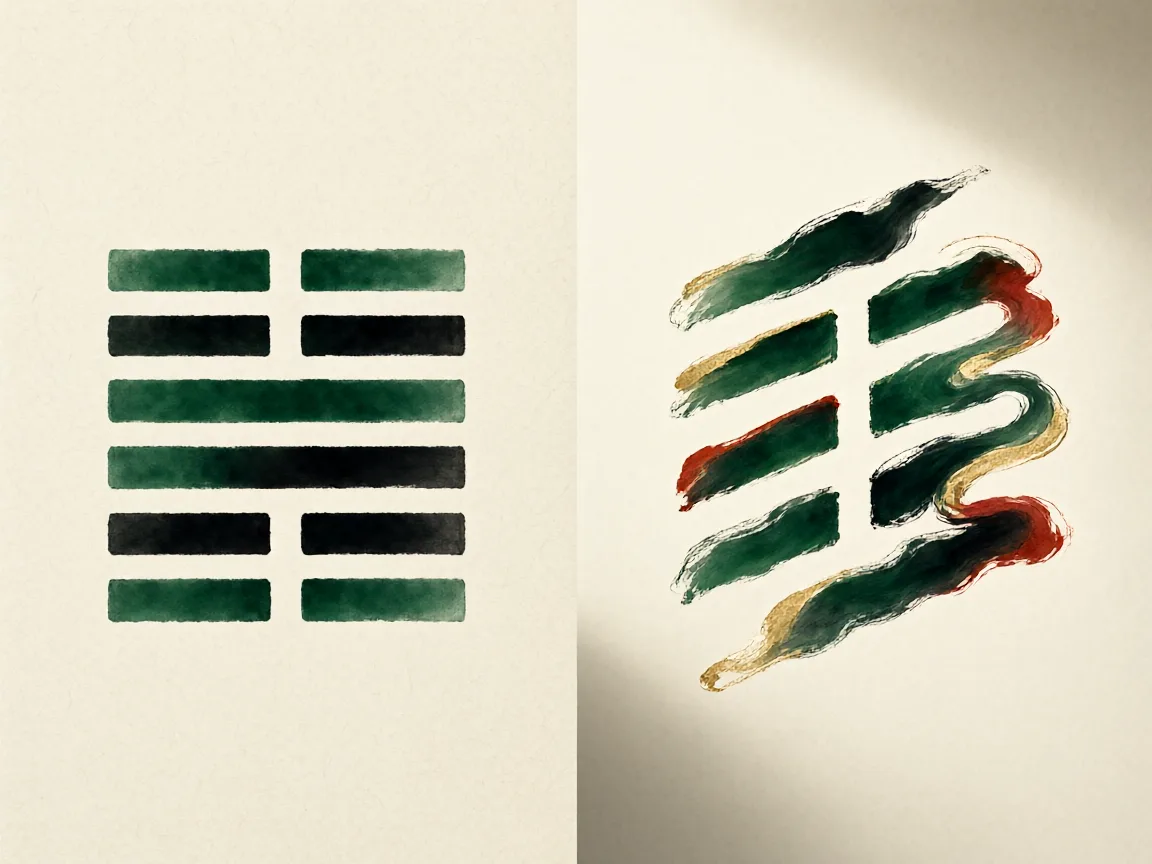
The Changed Hexagram: The Structure After Evolution
The changed hexagram is the new hexagram formed after the yin-yang conversion of moving yao. It represents the new structure or state that may ultimately form after the matter has undergone a process of change. If Old Yang turns to Yin and Old Yin turns to Yang, the hexagram constituted by these flipped yao positions is the changed hexagram. It reveals the potential face of the 'future tense,' displaying the tendency of results after the dynamic process concludes.
In interpretation, the changed hexagram often reflects the direction of event development more directly than the primary hexagram. However, it must be noted that the changed hexagram is not an absolute destiny, but a possible structure deduced based on current trends. It indicates the new configuration of the situation after the inquirer takes action, allowing for advance preparation or strategic adjustment to avoid passivity.
Moving Yao: The Focus and Hub of Change
Moving yao serve as the bridge from the primary hexagram to the changed hexagram and are the hub of the entire interpretation process. They indicate the specific position and breakthrough point of change. For instance, a moving first yao signifies turbulence in the nascent stage of affairs, while a moving top yao signifies a turning point of conclusion or extremity. The yao statement of the moving yao is the core basis for interpretation and requires careful examination, as it specifically points out matters, risks, or opportunities to note at the point of change.
In MysticFate, moving yao are highlighted and linked to their corresponding yao statement interpretations. This step requires the reader to translate abstract yao imagery into concrete action guidelines. Moving yao represent not only change but also the focal point of 'force.' Through in-depth analysis of the moving yao's statement, one can determine where active effort is needed or where restraint and defense are required, thereby mastering the rhythm of change.
Reading Differences Between Single and Multiple Moving Yao
Interpretation emphasis varies depending on the number of moving yao. When only one yao moves, its statement carries the highest weight as the absolute core of interpretation, and the relationship between the primary and changed hexagrams is most clear and direct. In this case, it is advised to primarily reference the moving yao's statement, supplemented by the primary hexagram's statement, with the changed hexagram serving as background reference. This single moving yao scenario is most common, featuring a short logical chain and strong directionality.
When two or more yao move, the situation becomes complex. Traditional rules dictate that for two moving yao, one usually consults the statements of the two moving yao in the primary hexagram, or prioritizes the primary hexagram's statement; for three or more moving yao, one often refers to specific classical annotation rules, such as 'for three moving yao, consult the statements of both the primary and changed hexagrams.' Multiple moving yao imply intense turmoil with multiple factors acting simultaneously; interpretation requires a macro grasp of overall trends, focusing on systematic balance and adjustment.
Common Misconceptions and Boundaries
A common misconception is viewing moving yao as an absolute prophetic tool that guarantees precise outcomes of specific events. In reality, the Yijing is a dynamic philosophical model; moving yao indicate trends, structures, and ways of response, not fate. Furthermore, many users attempt to seek more 'accurate' answers by repeatedly casting the hexagram, which is ineffective. Each casting corresponds to a different spatio-temporal state; repeated casting leads to information confusion and violates the principle that 'the Yijing does not allow duplication.'
The tool is used only to provide an analytical framework from a traditional cultural perspective and absolutely does not involve medical diagnosis, legal advice, investment advice, or psychotherapy. Users should view interpretation results rationally as auxiliary references for self-reflection and decision-making, not as the sole basis. For questions involving specialized fields, always consult relevant professionals and maintain clear cognitive boundaries for proper application.
How to View This in MysticFate
In MysticFate, viewing the primary hexagram means examining the static current situation. The system clearly displays the yin-yang arrangement of the six yao; users should focus on the overall energy field constituted by static yao. As the starting point, the primary hexagram provides the background for the event. By reading the primary hexagram's statement, one can quickly grasp the general nature of the current situation, which is the foundation for subsequent in-depth interpretation.
Viewing moving yao is key to understanding the core of change. The system highlights moving yao positions and links to corresponding yao statement interpretations. Users should combine the position of the moving yao (e.g., first yao representing the beginning, top yao representing the end) with the content of the yao statement to determine the specific focus of change. The changed hexagram displays the new structure after yao flipping, representing the possible face of affairs after evolution.
Important Note: Do not treat short-term indications as definite events. MysticFate's analysis aims to reveal trends and possibilities, not to prophesy predetermined results. Interpretation results should serve as opportunities for reflection, not absolute directives for action. Users must combine their actual contexts, judge rationally, and avoid excessive dependence on or misunderstanding of a single hexagram.
Frequently Asked Questions
What are the differences in interpretive weight when multiple yao move?
For one moving yao, that yao's statement is primary; for two moving yao, typically consult the statements of the two moving yao in the primary hexagram or the primary hexagram's statement; for three or more, focus on a comprehensive reading of the primary and changed hexagram statements. The greater the number, the more turbulent the situation, requiring a more macro-level grasp.
Must the changed hexagram be consulted if there are no moving yao?
No. No moving yao means the hexagram is stable and unchanged; the changed hexagram does not exist or lacks practical transformative significance. Interpretation focus should be entirely on the primary hexagram's statement, understanding the static current situation and the way of maintaining stability.
Does repeated casting yield more accurate results?
No. Traditional views hold that 'an affair should not be asked more than three times'; repeatedly casting for the same issue in a short time leads to muddled information, interfering with intuition and judgment. It is advised to reflect calmly or rephrase the question, rather than mechanically repeat the process.
Can moving yao predict specific dates or numerical results?
No. The Yijing provides trends in the development of affairs, structural changes, and coping strategies, not precise time points or specific values. Using it as a decision-making reference framework, rather than a precise prophetic tool, is the correct approach.
Go Deeper
This is the Fundamentals introduction. Future updates will add etymologies of key terms, differences among schools of thought, verifiable reference methods, and common misconceptions—following professional publishing standards.