The Duplication of Trigrams and the Formation of the Sixty-Four Hexagrams
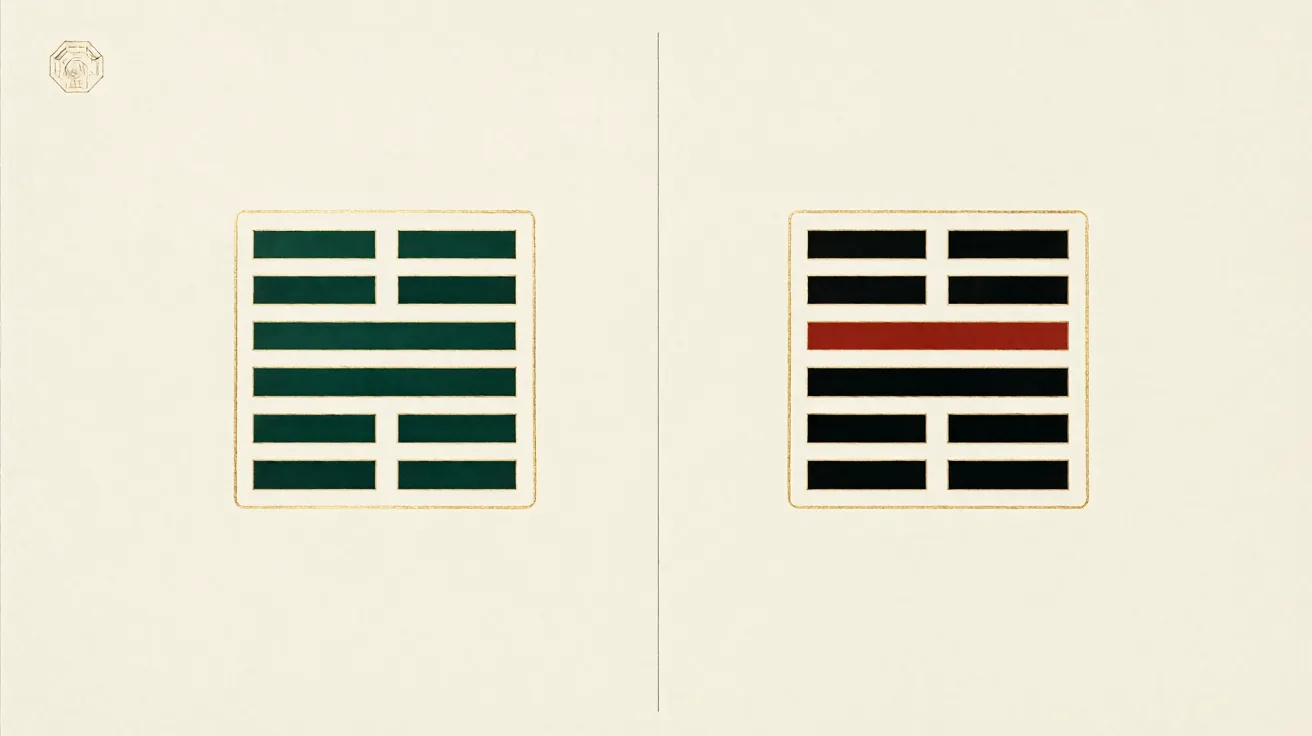
The foundation of the I Ching lies in the Eight Trigrams: Qian, Kun, Zhen, Xun, Kan, Li, Gen, and Dui. Each trigram consists of three lines, symbolizing the natural phenomena of heaven, earth, thunder, wind, water, fire, mountain, and marsh. When two trigrams are superimposed, one above the other, they form the sixty hexagrams of six lines each. This combinatorial method is not merely a mathematical permutation but embodies a dynamic model of yin-yang interaction and the transformation of all things. The superposition of upper and lower trigrams constitutes the complete hexagram image, concretizing abstract natural laws into a symbolic system for interpreting human affairs and change.
In this construction process, the trigrams, as fundamental units, are assigned specific attributes and symbolic meanings. For instance, Qian represents heaven and symbolizes firmness and strength, while Kun represents earth and symbolizes compliance and obedience. When two trigrams are combined vertically, the upper trigram represents the external context or outcome, while the lower trigram represents the inner motivation or cause. This structure establishes the Sixty-Four Hexagrams as a closed and self-consistent logical system, encompassing dimensions from natural observation to social ethics. Understanding this generative mechanism is the first step toward mastering the structural principles of the I Ching.
Functional Distinction Between Upper/Lower and Inner/Outer Trigrams
A hexagram of six lines comprises an upper trigram (the Outer Trigram) and a lower trigram (the Inner Trigram). The Inner Trigram typically represents the subject, the internal environment, or the cause of a matter, while the Outer Trigram represents the object, the external environment, or the developmental outcome. This distinction between inner and outer is crucial in interpretation. For example, in the Hexagram 48 (Well), the upper trigram is Kan (Water), representing danger or resources, while the lower trigram is Xun (Wind), representing compliance or penetration. Their combination suggests obtaining resources through compliance in precarious situations. The interaction between the inner and outer trigrams reveals the evolutionary path of phenomena from internal motives to external manifestations.
In certain schools of thought, the inner and outer trigrams also correspond to the relationship between 'home' and 'the world,' or 'private' and 'public.' The Inner Trigram is often closer to the individual's inner state and direct actions, whereas the Outer Trigram reflects social feedback and macroscopic trends. In the MysticFate system, initial conditions provided by the user are mapped to the Inner Trigram, while simulated external variables are mapped to the Outer Trigram, thereby generating the complete structure of six lines. This structured decomposition helps users clearly perceive the balance and conflict between internal and external factors, avoiding one-sided interpretations.

Line Sequence Order and Yin-Yang Attributes
The six lines are arranged from bottom to top, designated as Line 1 through Line 6. Odd-numbered positions are yang positions, while even-numbered positions are yin positions. Yang lines are depicted as solid horizontal lines, and yin lines as broken lines. When a yang line occupies a yang position, or a yin line occupies a yin position, it is termed 'properly placed' or 'in its correct position,' typically symbolizing harmony and stability; conversely, 'improperly placed' suggests change or challenges. Each line position carries specific symbolic significance, such as Line 1 representing the initial stage and Line 6 representing the ultimate limit.
The yin-yang nature of a line refers not only to its linear form but also to a dynamic state of energy. In interpretation, one must consider the line position in the context of the entire hexagram image. For example, the Line 5 (the second line from the top) in a yin position supporting the yang Line 5 of the upper trigram often symbolizes gentle assistance to firm and strong virtue. This micro-level structural analysis makes each line a critical node for observing change. In the MysticFate system, the software performs a weighted analysis of each line's yin-yang attribute and position, combining hexagram statements and line statements to provide multi-layered dynamic feedback, helping users identify the core issue of the current moment.
Textual Hierarchy: Hexagram Names, Statements, Line Statements, and Explanations
The text of the I Ching possesses a rigorous hierarchical structure. The hexagram name summarizes the central theme of the hexagram, such as 'Qian' representing the power of creation. The hexagram statement offers a holistic judgment of the entire hexagram image, providing macro-level guidance on fortune and misfortune. The line statements describe the specific state of each line, offering more targeted insights. Furthermore, the 'Tuan' Commentary explains the origin of hexagram names and statements, while the 'Xiang' Commentary expounds on philosophy from the perspective of hexagram and line images. These distinct textual levels collectively construct a complete interpretive framework.
Beginners often confuse the application contexts of hexagram statements and line statements. Hexagram statements are suitable for judging the general direction of the overall situation, while line statements are used to resolve issues at specific stages. For instance, when inquiring about the early stage of a career and obtaining the Qian hexagram, the hexagram statement 'Great Beginning, Prosperity, Perseverance' indicates a positive overall trend, but if the question concerns specific execution details, the corresponding line statements must be consulted. In the MysticFate system, the software automatically distinguishes whether the user is focusing on overall fortune or a specific node, prioritizing the display of relevant textual interpretations to avoid information overload and ensure interpretive precision.
Analysis of Hexagram Sequence Systems and Version Differences
The hexagram sequence in the received edition of the Zhou Yi does not arrange good and bad fortune by numerical order but follows a philosophical logic of 'complex interweaving.' For example, Qian is followed by Kun, reflecting the opposition of yin and yang; Pi is followed by Tai, illustrating that extremes reverse. Additionally, there are the Eight Palaces sequence (Jing Fang system), the Primeval Sequence (Fuxi system), and the Later Heaven sequence (King Wen system). The Eight Palaces emphasize the Na Jia divination method, while the Primeval and Later Heaven sequences focus on directional and cosmological models. These are distinct structural concepts that must not be conflated.
Many modern people mistakenly believe that the numerical sequence in the received edition (1 to 64) represents a ranking of fortune, where smaller numbers imply better luck or larger numbers imply worse luck. This is a common misconception. In reality, the sequence reflects only logical progression and has no direct linear relationship to fortune. During divination, interpretation should be based on the hexagram image obtained through random casting, not on its index number in the received edition. In the MysticFate system, the software strictly adheres to traditional divination rules, using the hexagram sequence solely as a retrieval index and never converting its numerical value into a weight for fortune, thereby ensuring objectivity in interpretation.
Common Misconceptions and Boundaries
When using the structure of the I Ching for self-exploration, its boundaries must be clearly defined. The I Ching does not provide deterministic predictions of events, such as 'it will definitely rain tomorrow' or 'stocks will definitely rise.' It is a tool for simulated thinking, intended to reveal the laws and potential trends of change. Therefore, hexagrams should not be viewed as fatalistic verdicts but as reference frameworks for reflection and decision-making. Simultaneously, major decisions in fields such as medicine, law, and investment must rely on professional domain knowledge and cannot depend solely on I Ching principles.
Another common misconception is the attempt to overly specificize hexagram images. For example, seeing the Li hexagram and immediately concluding it relates exclusively to fire or the eyes, while ignoring that Li also represents light, dependence, and civilization. Such narrow symbolic interpretation leads to misjudgment. In the MysticFate system, the software employs multi-dimensional contextual analysis to alert users to avoid single-image traps and clearly marks the range of predictive uncertainty. The system does not disclose specific algorithms but emphasizes that its logic is based on traditional I Ching axioms, ensuring users find a balance between rationality and intuition.
How to Interpret Within the MysticFate System
In the MysticFate system, interpretation should first focus on the structural decomposition of the hexagram image. Users should sequentially examine the combination of upper and lower trigrams, clarifying the inner motives represented by the Inner Trigram and the external environment reflected by the Outer Trigram. Subsequently, closely observe the yin-yang forms and positions of the six lines, identifying states of 'properly placed' and 'improperly placed,' which reflect critical nodes in energy flow. By reading the structure first, users can grasp the balance and tension of the situation from a macro level, avoiding a direct plunge into the literal meaning of the text.
Next, the relationship between the hexagram name and the changing hexagram should be considered to understand the direction of change. The changing hexagram represents the potential trend of the situation, while the original hexagram displays the current static structure. In the MysticFate system, users are advised to follow the principle of 'reading the structure before the text,' first establishing the skeleton of the hexagram image and then filling in the specific interpretations of hexagram and line statements. In this process, the numerical sequence of hexagrams should never be equated simply with a grade of fortune; numbers are used only for indexing, not as a scale of luck.
Finally, it must be clear that this tool is intended to provide a thinking framework rather than predict specific events. In the MysticFate system, the software guides users to focus on the logical deduction behind the hexagram image, rather than on specific event predictions. Through this structured perspective, users can internalize I Ching principles as a reference for decision-making, view uncertainty rationally, thereby respond to changes with composure in real life, and achieve the deepening and elevation of self-awareness.
Frequently Asked Questions
What do the upper and lower trigrams represent in interpretation, respectively?
The Upper Trigram (Outer) typically represents the external environment, outcome, or object; the Lower Trigram (Inner) represents the internal mindset, cause, or subject. Interpretation requires analyzing the interactive relationship between the two.
Does the size of the number in the received hexagram sequence indicate fortune?
No. The hexagram sequence is a logical evolutionary sequence, not a rank of fortune. The numbers from 1 to 64 are used only for retrieval; fortune depends on the hexagram image itself and the changes in line positions.
What is the difference between 'properly placed' and 'improperly placed' in line positions?
'Properly placed' refers to a yang line in a yang position or a yin line in a yin position, symbolizing harmony; 'improperly placed' refers to a mismatch of yin and yang, symbolizing challenges and change. The actual impact must be judged in conjunction with specific line statements.
How does the MysticFate system distinguish between different hexagram sequence systems?
The system defaults to the received edition logic for divination, but supports differences in schools such as the Eight Palaces Na Jia in advanced options. Users can select the applicable system according to their own tradition.
Go Deeper
This is the Fundamentals introduction. Future updates will add etymologies of key terms, differences among schools of thought, verifiable reference methods, and common misconceptions—following professional publishing standards.