
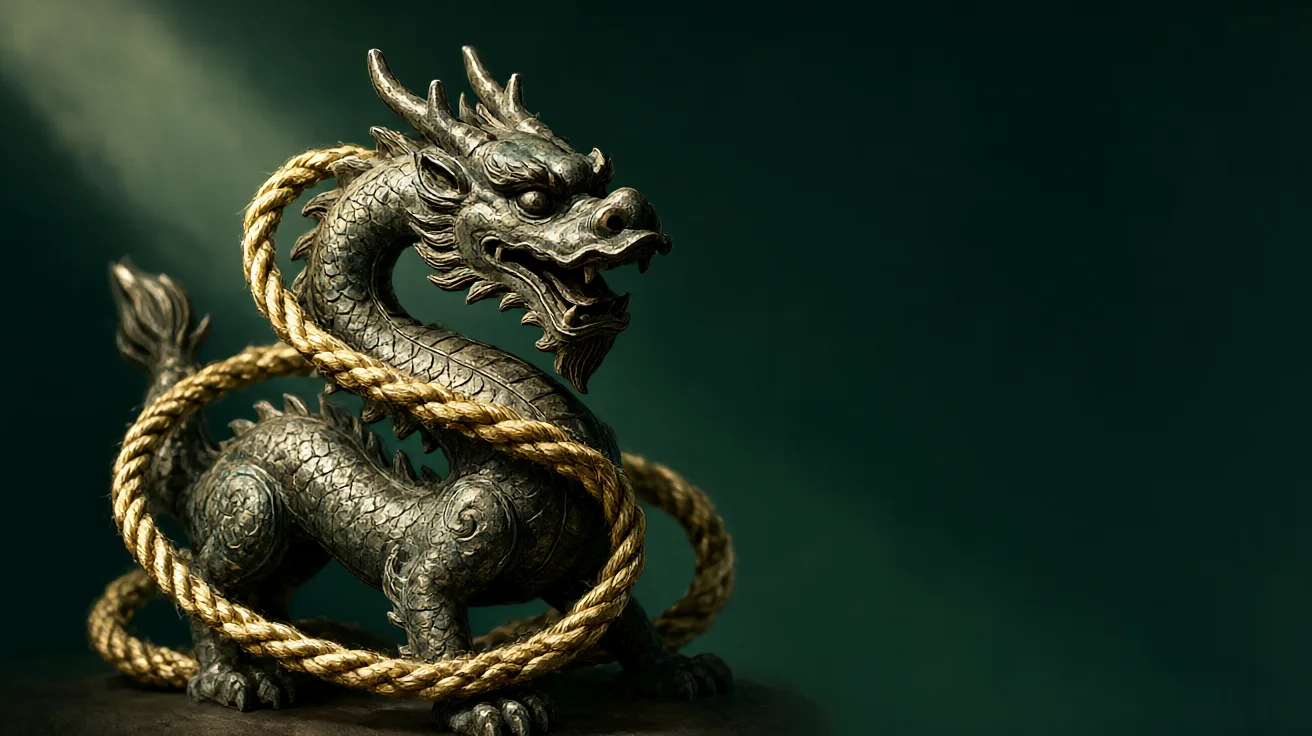
Tai Sui: The Yearly Deity in the Calendar and the Symbol of the Ruling Year
In traditional calendrical systems, Tai Sui refers to the 'Yearly Deity' presiding over the current year, serving as the personified symbol of the ruling year. Ancient people believed that celestial stars were connected to human fortunes; thus, they established the Sixty Jiazi Tai Sui Star Lords, with one Tai Sui taking duty each year. For instance, the Jiazi year corresponds to the first of the Sixty Jiazi Tai Sui, while the Yichou year corresponds to the second. This rotation system was not arbitrarily set but was based on the Stem-Branch calendar system, dividing time into sixty cycles, each featuring a distinct Tai Sui image that carries the specific energetic imagery of that year.
It must be clarified that Tai Sui itself is a concretized expression of a temporal coordinate, marking the dominant energy of 'this year' within the traditional cultural cognitive framework. It does not directly equate to auspicious or inauspious outcomes but provides a reference system. While historical periods and different schools may have slight variations in the specific divine names and functional descriptions of the Tai Sui Star Lords, their core function as the 'ruler of the ruling year' remains consistent. To understand Tai Sui, one should first view it as a cultural symbol and a time-management tool, rather than an entity deity with supernatural intervention capabilities.
The Native Year: The Convergence of the Zodiac and Tai Sui
The Native Year refers to the year in which a person's birth zodiac matches the zodiac associated with the current annual Tai Sui. Since the twelve zodiac signs correspond to a twelve-year cycle, a person born in the Year of the Dragon encounters their Native Year during a Dragon year, and similarly for those born in the Year of the Tiger. This overlap occurs approximately every twelve years. In traditional folk beliefs, the Native Year is called 'Value Tai Sui' (or 'Facing Tai Sui'), signifying that the individual's zodiac directly faces the annual Tai Sui, creating an overlap in energy fields, and is therefore considered a year requiring particular attention.
The common folk saying regarding the 'Value Tai Sui' in the Native Year is 'Sitting under the Tai Sui brings trouble without joy,' but this is merely a colloquial summary, not a rigorous theoretical derivation. From the perspective of folk psychology, the Native Year is assigned symbolic significance as a 'sensitive period' or 'turning point' due to the zodiac overlap. Many people choose to wear red accessories or clothing during their Native Year; this behavior functions more as a psychological suggestion and self-reminder aimed at boosting confidence and maintaining caution, rather than as superstition regarding physical protection.

Offending Tai Sui: Subtypes of Clash, Punishment, Harm, and Break
'Offending Tai Sui' is a broad concept that encompasses situations where zodiac signs other than the Native Year have specific relationships with the annual Tai Sui. It is specifically divided into four categories: Clash Tai Sui, Punishment Tai Sui, Harm Tai Sui, and Break Tai Sui, plus the Value Tai Sui of the Native Year, totaling five forms. Clash Tai Sui refers to a zodiac opposing the Tai Sui, such as the clash between Rat and Horse or Rabbit and Rooster, symbolizing change and conflict; Punishment Tai Sui refers to a zodiac forming a punitive relationship with the Tai Sui, such as the three-way punishment among Tiger, Snake, and Monkey, symbolizing internal knots and pressure.
Harm Tai Sui refers to a zodiac forming a harmful relationship with the Tai Sui, such as the harm between Rat and Goat, symbolizing hidden depletion and trust crises; Break Tai Sui refers to a zodiac forming a breaking relationship with the Tai Sui, such as the break between Rat and Rooster, symbolizing risks of rupture beneath superficial harmony. Different zodiac signs fall into different Offending Tai Sui categories in different ruling years. For example, a person born in the Dragon year offends Clash Tai Sui in a Dog year and offends Harm Tai Sui in a Rabbit year. These classifications originate from traditional Five Elements generation and control theories, aiming to describe potential tensions in interpersonal or environmental contexts, rather than to determine absolute disasters.
The Boundary of Folk Models Versus Scientific Criteria
Tai Sui, the Native Year, and Offending Tai Sui all belong to empirical models within traditional culture. Their foundation lies in classical philosophical frameworks such as Yin-Yang Five Elements and the Stem-Branch calendar, which are fundamentally different from modern scientific empirical methods. In folk contexts, Offending Tai Sui is often associated with 'troubles in all matters,' but this is merely a risk metaphor within cultural narratives. There is no scientific evidence proving a causal link between zodiac signs and annual health or wealth. Equating folk symbols with scientific facts constitutes a cognitive confusion.
The practical function of 'Offending Tai Sui' is closer to a 'risk warning tool,' similar to a modern risk assessment checklist. It does not predict that 'something will definitely happen' but suggests that one 'should be cautious.' For instance, Clash Tai Sui signals change, which may imply psychological preparation for events such as moving or changing jobs; Punishment Tai Sui signals internal knots, which may imply the need to resolve long-standing interpersonal conflicts. This interpretive approach preserves the utility of folk customs while stripping away their fatalistic color, making it an adjustable psychological reference rather than a sentence of fate.
How to View This in MysticFate
The zodiac and ruling year features in MysticFate aim to provide users with a structured presentation of traditional folk information. In the 'Zodiac' module, users can view the name and attributes of the current annual Tai Sui, as well as the relationship types between each zodiac sign and the Tai Sui (such as Value, Clash, Punishment, Harm, and Break). The interface clearly labels whether a zodiac sign 'Offends Tai Sui' in a specific year and the specific type, for example, displaying 'Rat zodiac offends Clash Tai Sui in the Horse year.' This helps users quickly locate their position within the folk framework and access the traditional cultural context.
This feature displays static reference charts based on traditional calendars and folk algorithms, rather than dynamic predictive models. The 'Offending Tai Sui' indicator seen by the user merely signifies that the zodiac sign holds a specific configuration in the Five Elements generation and control relationship with the annual Tai Sui; it does not include predictions of specific events regarding personal health, wealth, or relationships. The App does not provide definitive conclusions such as 'you will lose money this year' or 'you will fall ill next year.' Its design intent is to provide cultural knowledge and customary references, helping users understand traditional calendrical logic, rather than replacing decision-making bases in professional fields.
Common Misconceptions and Boundaries
One common misconception is equating 'Offending Tai Sui' with 'inevitable bad luck' or 'certain financial loss or illness.' This results from absolutizing and catastrophizing folk metaphors. The traditional saying 'trouble without joy' is extreme rhetoric used to emphasize caution, not a statistical fact. In reality, many people may experience stable or even rising years during their Offending Tai Sui year, and vice versa. Forcibly linking zodiac years with specific negative events lacks scientific basis and ignores the complexity of individual effort and environmental factors.
Another misconception is believing that 'the Native Year' or 'Clash Tai Sui' can 'resolve' all misfortune through wearing red items or performing specific rituals. Within traditional culture, 'resolution' typically refers to psychological adjustment, cautious behavior, or symbolic rituals, aiming to alleviate anxiety and enhance a sense of control, rather than physically eliminating potential risks. No folk ritual guarantees the prevention of disease, accidents, or financial loss. Equating rituals with insurance is a cognitive bias that may lead to neglecting genuine preventive measures.
Summary: Viewing Traditional Symbol Systems Rationally
In summary, Tai Sui is the symbol of the yearly deity for the ruling year, the Native Year is the sensitive period where the zodiac and Tai Sui converge, and Offending Tai Sui is the collective term for zodiac signs experiencing tensions such as Clash, Punishment, Harm, or Break with the Tai Sui. These three elements constitute a complete traditional time-zodiac interaction model, aiming to help people perceive time rhythms and adjust psychological expectations through a symbolic system. Its core value lies in cultural identity and psychological adjustment, rather than providing deterministic fate predictions.
On platforms like MysticFate, these concepts are presented to popularize traditional cultural knowledge and help users understand calendrical logic and folk contexts. Users should use this information with rational and critical thinking, recognizing that 'Offending Tai Sui' does not equal 'something will definitely happen,' and 'the Native Year' does not equal 'inevitable disaster.' Traditional models are a condensation of experience, not scientific laws. Respect tradition, while also respecting science and rationality, avoiding the alienation of folk symbols into shrouds of fate or false placebos.
Frequently Asked Questions
Is the Native Year the Same as Offending Tai Sui?
In folk classifications, the Native Year is a form of 'Value Tai Sui' and is one special type of Offending Tai Sui. However, Offending Tai Sui also includes other types such as Clash, Punishment, Harm, and Break. Therefore, the Native Year is part of Offending Tai Sui, but Offending Tai Sui is not limited to just the Native Year.
Does Offending Tai Sui Mean One Will Definitely Fall Ill or Lose Money?
No. Offending Tai Sui is a risk metaphor in traditional folk culture, indicating that the zodiac sign has a specific generation-control relationship with the annual Tai Sui, serving as a reminder to be cautious. There is no scientific basis proving it will inevitably lead to illness or financial loss, and it should not serve as a basis for medical or financial decisions.
Can MysticFate's zodiac feature predict my specific good or bad luck this year?
No. This feature only displays the relationship types between zodiac signs and Tai Sui based on traditional calendars (such as Clash, Punishment, etc.), belonging to cultural information display. It does not provide deterministic good-or-bad luck predictions, nor does it replace advice from professional fields.
Are the Definitions of Offending Tai Sui the Same Across Different Schools?
Not entirely. Different almanacs or schools may have differences in the specific zodiac combinations for 'Punishment' and 'Harm,' for example, some schools subdivide three punishments or four defeats. MysticFate adopts mainstream folk classifications, but users should be aware that such concepts have version differences and no single standard.
Go Deeper
This is the Fundamentals introduction. Future updates will add etymologies of key terms, differences among schools of thought, verifiable reference methods, and common misconceptions—following professional publishing standards.