
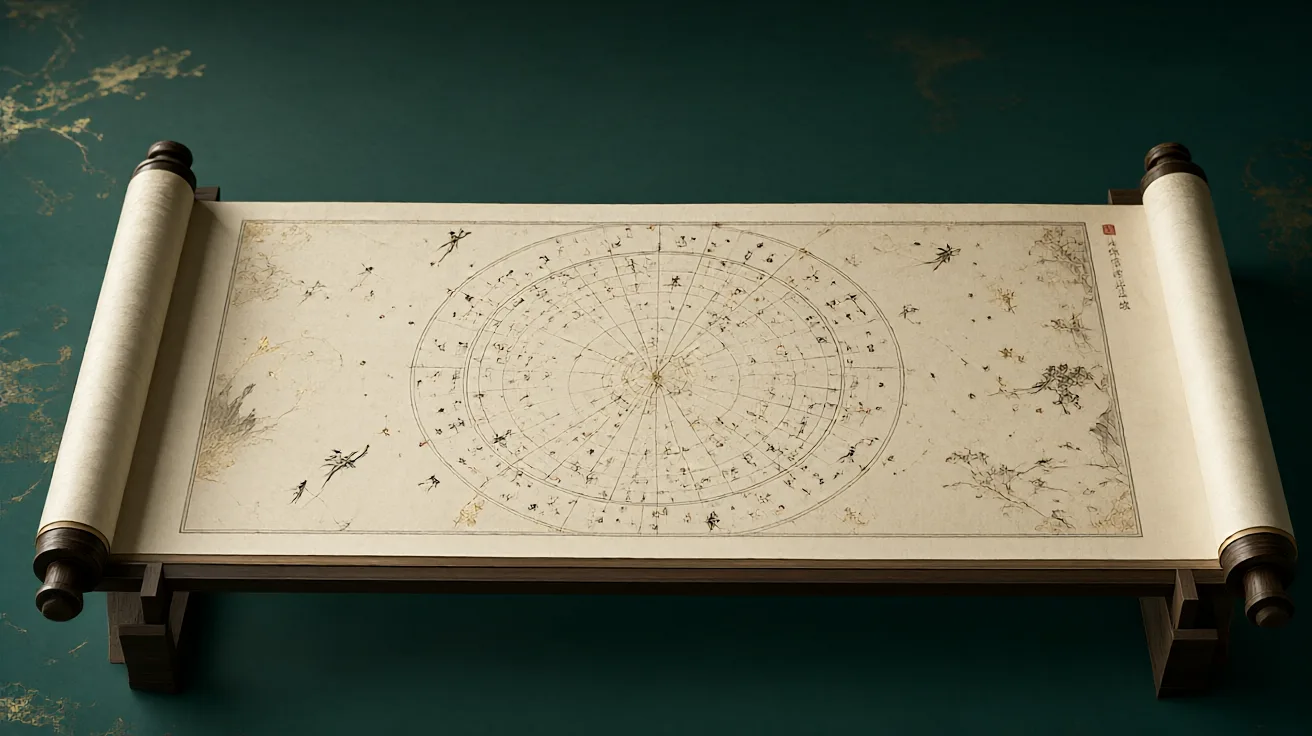
Cultural Origins of Stellar Partitioning and the Four Directions Seven Mansions
The Twenty-Eight Mansions are essentially a stellar partitioning system established through long-term observation, aiming to identify celestial phenomena rather than mystical attributions. This system divides the equatorial band into twenty-eight zones, integrating pre-Qin to Han Dynasty astronomy and astrology, recording natural celestial events; it represents objective astronomical coordinates rather than subjective fate directives.
The Four Directions Seven Mansions correspond to the Azure Dragon (East), White Tiger (West), Vermilion Bird (South), and Black Tortoise (North), linking them to spring wood, autumn metal, summer fire, and winter water, respectively. The Eastern Mansions are Jiao, Geng, Di, Fang, Xin, Wei, and Ji; the Western are Kui, Lou, Wei, Mao, Bi, Zi, and Shen; the Southern are Jing, Gui, Liu, Xing, Zhan, Zhang, Yi, and Zhen; the Northern are Dou, Niu, Nü, Xu, Wei, Shi, and Bi. This correspondence system profoundly influences traditional spatiotemporal concepts and Feng Shui layouts, forming the basic framework for understanding Huangli mansion markers.
In the Huangli, the twenty-eight mansions take turns as daily duty markers, forming a cyclical loop, primarily indicating the day's celestial background. Its core function is time marking and celestial correspondence, not directly assigning absolute auspicious or inauspicious judgments. When reading, one must strictly distinguish between astronomical observation records and folk application boundaries, maintaining scientific rationality and avoiding misreading celestial records as fate directives.
Calendrical Marking Mechanism of Huangli Duty Mansions
Huangli duty mansions originate from approximate calculations of celestial movement cycles, typically appearing beside dates as celestial attribute indicators. It must be clear that this is merely a time marker; auspicious/inauspicious attributes were assigned by later folk customs, not inherent to the astronomical phenomenon itself; the two must not be confused. Understanding this mechanism helps avoid excessive superstition or scientific misinterpretation.
Duty derivation is based on the lunar sidereal cycle, i.e., the motion of lunar phases against the stellar background. Because the moon's speed is not entirely uniform, different schools have subtle differences in calculation nodes, causing the duty mansion for the same date in different Huangli versions to potentially be inconsistent. Interpretation requires clarifying the Huangli school background, such as Gregorian calendar conversion standards and solar term calculation methods, to ensure marker accuracy.
Modern digital Huangli tools usually adopt standardized algorithms, but their handling of boundary conditions like leap months and solar term transition moments may differ. Users should pay attention to the calendrical standards in tool descriptions. The modern application of duty mansions lies primarily in cultural transmission and folk reference, not precise astronomical calculation. A rational and objective attitude aids in correctly understanding its historical status and modern value.
Distinction from the Twelve Duty Gods and the Yellow Path/Black Path System
The Twelve Duty Gods, or the Twelve Establishment-Removal deities, are derived from lunar phases and earthly branch combinations, serving as time-cycle auspicious/inauspicious markers. The Yellow Path/Black Path twelve deities originate from stem-branch calculations and spirit-sha theory, involving calculations for the placement of spiritual markers like Heaven Virtue and Month Virtue; the system is complex and independent. It is strictly forbidden to mix the twenty-eight mansions with them, as they stem from entirely different derivation logic; cross-system associations are typical calendrical confusion errors.
The Twenty-Eight Mansions are stellar background markers, with core logic based on lunar apparent motion; the Twelve Duty Gods and Yellow Path/Black Path belong to internal spirit-sha derivations within the stem-branch calendar, with core logic based on yin-yang and five-element interactions. There is no direct connection between the two in time basis, derivation formulas, or auspicious/inauspicious judgment. The correct approach is to understand the independent logic of each system separately, avoiding logical fallacies caused by forced associations, ensuring the professionalism and accuracy of Huangli reading.
For example, if the day's duty mansion is 'Jiao Wood Dragon,' refer to its attributes within the Twenty-Eight Mansions system; that day's Twelve Duty God might be 'Break,' indicating ruin; the Yellow Path/Black Path might be a 'Black Path Day.' These three exist independently, jointly constituting the day's marker set. When reading, view them separately; do not ignore the inauspiciousness of the Twelve Duty God because the Twenty-Eight Mansion attribute is auspicious. Tools usually display them in separate columns; users need the ability to distinguish them, recognizing the independence of the systems.
Differences in Calendar Schools and Version Selection
Calendars compiled by different dynasties, regions, and schools show significant differences in details, arising from varying choices of calendrical epochs, precession handling, precision of solar term transition calculations, and the transmission of spirit-sha rules. For example, some schools determine duty mansions using the constant qi method, others using the constant month method, causing the lunar date or mansion name corresponding to the same Gregorian date to differ across Huangli versions from different schools; users should be wary of version differences.
Modern circulating Huangli almanacs include traditional professional editions, simplified popular modern editions, and specific regional folk editions. When reading, users should first confirm the applicable region and calendrical standard. If involving cross-regional activities or precise time selection, it is recommended to use Huangli compiled based on national standards or authoritative astronomical observatory data. For daily cultural awareness, generic Huangli can be used, but users must recognize its limitations and maintain critical thinking.
Calendar differences are more evident in auspicious/inauspicious item entries; different schools emphasize different spirit-sha for 'suitable/unsuitable' determinations, some prioritizing Heaven Virtue and Month Virtue, others the Twelve Establishment-Removal gods. Therefore, no 'absolutely correct' universal Huangli exists, only one that is 'correct within a specific system.' Tools that annotate the calendrical school or version source will greatly enhance reading credibility. When reading, understand the underlying system logic and do not blindly superstitiously follow a single version.
Strict Boundaries Between the Twenty-Eight Mansions and Modern Constellations
The Twenty-Eight Mansions are often misread as 'Chinese constellations,' which is a conceptual confusion. The Twenty-Eight Mansions are based on stellar region partitioning, essentially an astronomical coordinate system; modern constellations are a Western astrological symbol system, based on the division of the zodiac belt and solar motion trajectory. The two have no connection in astronomical basis, cultural connotation, or application logic and cannot be interchanged; equating them is strictly prohibited.
Twenty-Eight Mansion names correspond to specific constellation asterisms; for example, Jiao Mansion corresponds to Alpha and Beta Virginis, but ancient constellation boundaries do not fully overlap with modern International Astronomical Union constellation boundaries. For instance, Heart Three (Antares) is within the Heart Mansion, but other stars in Scorpius may belong to different constellation asterisms. It is absolutely impossible to make analogies like 'You are a Scorpio, so you are Heart Mansion,' as they belong to different civilizational systems.
In Huangli reading, it is strictly forbidden to conflate Twenty-Eight Mansion markers with modern constellation fortunes. Huangli mansion auspiciousness/inauspiciousness is derived from the traditional calendrical spirit-sha system and has no logical connection to zodiac belt astrological fortunes based on the sun's position. If a tool states things like 'Today's Heart Mansion corresponds to Scorpio fortune,' these are serious knowledge errors. When reading the Huangli, one should completely abandon constellation thinking, return to the traditional calendrical essence, and ensure cognitive rigor.
How to Read It in MysticFate
In digital Huangli tools like MysticFate, the Twenty-Eight Duty Mansions are usually marked with icons or text in prominent date locations. Users should locate the target date, find the 'Duty' or 'Mansion' label, and identify the current Twenty-Eight Mansion name and attributes, such as Jiao Wood Dragon or Geng Metal Dragon. Tools usually color-code or icon-distinguish mansions to facilitate quick identification of five-element attributes and directions; operations are simple and intuitive.
When displaying Twenty-Eight Mansions, tools often provide brief prompts combined with 'auspicious/inauspicious' attributes, based on traditional folk spirit-sha rules, not scientific prediction. Users must note that 'suitable' and 'unsuitable' items in the interface should be comprehensively referenced in conjunction with markers like the Twelve Duty Gods and Yellow Path/Black Path, not judged solely by the single Twenty-Eight Mansion marker. Some tools provide a 'Mansion Details' pop-up, including constellation diagrams, associated directions, and traditional symbolism; readers can expand to understand the background, noting that this is cultural reference.
In MysticFate, users can also view specific 'Duty Mansion Spirit' names, such as 'Heaven Official' or 'Earth Official,' spirit-sha personifications. Tools may combine the Twenty-Eight Mansions with the concept of 'Twenty-Eight Mansion Duty Deities,' displaying their divine office attributes. If a 'Comparison View' function is provided, users can horizontally compare markers for the same date across different systems, aiding in building system differentiation cognition and avoiding confusion. Use tool functions rationally, confirm the calendrical school adopted, and maintain cultural cognition with a scientific attitude.
Common Misconceptions and Boundaries
The primary misconception is equating the Twenty-Eight Mansions with modern constellation fortunes or believing mansion markers can directly predict specific event outcomes. The Twenty-Eight Mansions are calendrical markers; their auspicious/inauspicious attributes are abstract concepts derived from traditional folk spirit-sha systems, lacking the ability to predict specific personal events like investment fluctuations, disease recovery, or legal judgments. It is strictly prohibited to use Huangli mansions for medical decisions, legal strategies, investment/financial management, or psychological diagnosis; these professional fields must be handled by licensed professionals based on scientific evidence and professional regulations.
Another misconception is believing that all Huangli almanac Twenty-Eight Mansion markers are identical, ignoring differences in calendar schools and versions. Different schools have variations in solar term calculations, leap month handling, and spirit-sha rules, causing potential differences in markers for the same date. Readers should not blindly trust a single source but understand calendrical complexity. Furthermore, specific personal fate predictions or absolute auspicious/inauspicious judgments must not be provided based on Twenty-Eight Mansion markers; Huangli information serves only as a traditional cultural reference and folk experience, not a basis for decision-making.
Boundary norm requirement: Huangli reading content based on the Twenty-Eight Mansions must not disclose specific derivation algorithm details or internal rule logic, avoiding technical abuse or mystification. No form of 'cracking,' 'changing fate,' or 'resolution' rituals should be recommended as scientific solutions. All interpretations should be limited to cultural historical background, calendrical knowledge popularization, and folk reference levels. Users must maintain a rational and critical attitude, viewing the Huangli as part of traditional cultural heritage, not an ultimate guide for life decisions, ensuring compliance and safety in information usage.
Frequently Asked Questions
Are the Twenty-Eight Mansions the Chinese Version of Modern Constellations?
No. The Twenty-Eight Mansions are a Chinese ancient astronomical stellar partitioning system based on actual celestial observation; modern constellations are a Western astrological symbol system based on zodiac belt division. The two differ entirely in astronomical basis, cultural connotation, and application logic; equating or confusing them is strictly prohibited.
Are the Twenty-Eight Duty Mansions in the Huangli the Same as the Twelve Duty Gods?
No. The Twenty-Eight Duty Mansions are based on the lunar sidereal cycle, marking the celestial background; the Twelve Duty Gods (Twelve Establishment-Removal) are based on lunar phases and earthly branch combinations, belonging to time-cycle auspicious/inauspicious markers. The two derivation systems are independent with no direct connection; they must be distinguished when reading.
Can Tomorrow's Stock Price Trend Be Predicted Based on Twenty-Eight Mansion Markers?
No. The Twenty-Eight Mansions are traditional calendrical cultural markers and possess no scientific predictive capability. It is strictly prohibited to use Huangli information for stock, financial, or other investment decisions; such predictions belong to professional fields and must rely on economic data and professional analysis, not folk calendrical methods.
Is It Normal for Twenty-Eight Mansion Markers to Be Inconsistent Across Different Huangli Versions?
Yes. Due to differences in calendrical schools, epoch selection, and solar term calculation precision, different Huangli versions may have discrepancies in mansion markers for the same date. Users should understand the calendrical standards and school background of the Huangli they are using, view differences rationally, and not blindly superstitiously follow a single version.
Go Deeper
This is the Fundamentals introduction. Future updates will add etymologies of key terms, differences among schools of thought, verifiable reference methods, and common misconceptions—following professional publishing standards.