
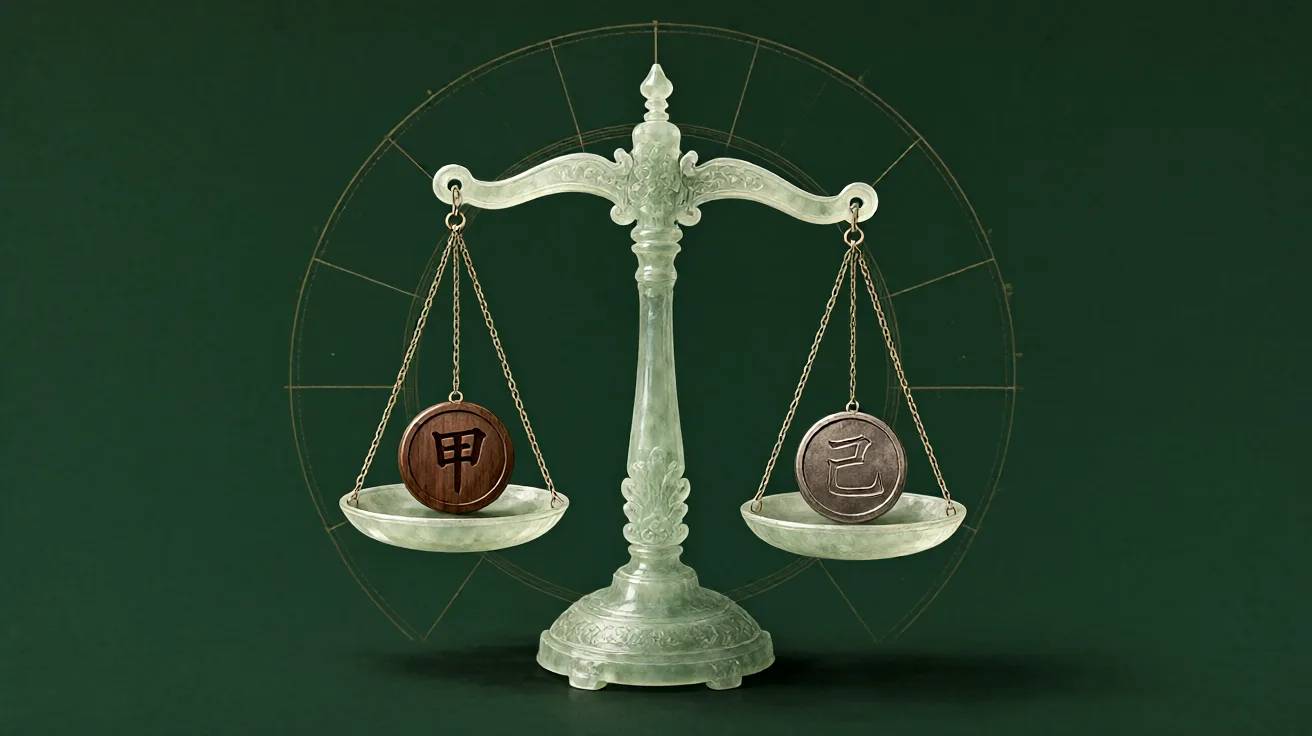
Clarifying Basic Concepts: The Hierarchical Distinction Between Heavenly Stems and Earthly Branches
The Five Harmonies of Heavenly Stems (Jia-Ji, Yi-Geng, Bing-Xin, Ding-Ren, Wu-Gui) and the Six Harmonies of Earthly Branches (Zi-Chou, Yin-Hai, Mao-Xu, Chen-Xu, Si-Shen, Wu-Wei) constitute two independent systems within Bazi. Heavenly Stems represent external, overt, and dynamic energy, primarily reflecting interactions in interpersonal relationships, external events, and surface phenomena; Earthly Branches represent internal, covert, and static structure, focusing on foundation, family environment, and deep support. Heavenly Stem harmonies emphasize 'motion,' often indicating the flow and transformation of energy; Earthly Branch harmonies emphasize 'stillness' or 'storage,' reflecting the harmony and stability of internal structures. Understanding this hierarchical distinction is the foundation for differentiating the two; they must not be conflated.
From the perspective of the Five Elements' generation and control cycles, the Five Harmonies of Heavenly Stems are based on yin-yang pairing, such as Yang Jia paired with Yin Ji, emphasizing a dynamic balance shifting from control to harmony, often accompanied by the transformation of elemental forces; the Six Harmonies of Earthly Branches are based on the spatiotemporal flow of the twelve branches and the interaction of yin-yang qi, reflecting greater spatial proximity and temporal periodicity. In terms of scope of action, Heavenly Stem harmonies can occur between adjacent or non-adjacent stems provided no strong clash or control exists; Earthly Branch harmonies are primarily limited to adjacent branches, where non-adjacent ones require hidden stem emergence or clash/control triggers to act. Beginners often mistakenly assume that a Heavenly Stem harmony necessarily implies an Earthly Branch harmony; this is a fundamental error, as the two follow entirely different logical rules.
The Nature of Harmony: Not an Inevitable Elemental Transformation
The most significant misconception is equating 'harmony' with 'transformation.' In orthodox Ziping theory, harmony merely signifies attraction, binding, or restraint; it does not directly equate to elemental transformation. Transitioning from harmony to transformation requires strict conditions: seasonal support, the relative strength of the harmonic force, the absence of clash and control, and the lack of interference from other elements. If these conditions are not met, the harmony functions only as a 'bond,' restraining the original elemental force rather than transforming into a new element. For example, the transformation of Jia-Ji harmony into Earth requires birth in the months of Chen, Xu, Chou, or Wei, with strong Earth qi; if born in spring when Wood is vigorous, the Jia-Ji harmony not only fails to transform into Earth but may actually restrain Jia Wood's ability to generate Fire or Ji Earth's ability to generate Metal, resulting in a weakened force.
Another characteristic of harmony is 'clash resolution.' When a clash or control appears in the natal chart or yearly luck cycles, the harmony is broken. For instance, if the Jia-Ji harmony encounters a clash from Yin or Mao, or if the Zi-Chou harmony encounters a clash from Wu or Xu, the existing harmonious relationship is disrupted, potentially triggering upheaval. Analyzing harmony must always be considered within the context of the global clash, control, punishment, and harm; it cannot be viewed in isolation. Harmony is part of a dynamic balance and can change at any time due to external forces. Understanding that 'harmony does not necessarily imply transformation' is a core advanced concept, requiring practical experience to grasp the subtle shifts in power and avoid rigid application.
Specific Applications and Significance of the Five Heavenly Stem Harmonies
In the natal chart, the Five Heavenly Stem Harmonies primarily adjust elemental forces and suggest event attributes. The Jia-Ji harmony signifies integrity and cooperation, benefiting land; the Yi-Geng harmony signifies a balance of rigidity and flexibility, benefiting craftsmanship and metals; the Bing-Xin harmony signifies civilized brilliance, benefiting culture and media; the Ding-Ren harmony signifies flowing wisdom, benefiting reform; the Wu-Gui harmony signifies inclusive storage, benefiting wealth. These associations must be judged comprehensively in conjunction with the chart owner's gender, social role, and annual luck. In terms of relatives, a harmony between the Month Stem and Day Stem often suggests close sibling relationships or deep cooperative ties; if the harmony transforms into an unfavorable element, cooperation is compromised, whereas if it transforms into a favorable element, profit is gained. A harmony between the Day Stem and Month Stem also suggests that early life was significantly influenced by the family.
In annual and decadal luck cycles, the Five Heavenly Stem Harmonies mark significant turning points. When the luck cycle's stem harmonizes with a stem in the natal chart, if it transforms into a favorable element, it indicates auspiciousness, such as promotion, marriage, or financial gain; if it transforms into an unfavorable element or binds a favorable element, it indicates misfortune, such as stagnation, financial loss, or illness. The Day Stem represents the chart owner; its harmony with the luck cycle's stem has the greatest impact, often corresponding to major personal milestones like engagement, hiring, or retirement. Judging auspiciousness must always be based on the natal chart's preferences and taboos, accurately assessing the impact of the transformed element on the original chart's balance.
Specific Applications and Significance of the Six Earthly Branch Harmonies
The Six Earthly Branch Harmonies focus on foundations, environment, and the stability of internal structures. The Zi-Chou harmony signifies moistness and privacy, benefiting water-based repositories; the Yin-Hai harmony signifies wood growth, benefiting emotional development; the Mao-Xu harmony signifies fire brilliance, benefiting arts and culture; the Chen-Xu harmony signifies pure metal, benefiting finance and law; the Si-Shen harmony signifies water wisdom, benefiting healthcare and change; the Wu-Wei harmony signifies earth inclusiveness, benefiting real estate and marriage. These associations must be interpreted in the context of specific charts and should not be generalized. The stability of Earthly Branch harmonies gives them special value in assessing marriage, family, and residence; for example, a harmony between the Day Branch (spouse palace) and another branch suggests the spouse has a partner or special traits, whereas a clash indicates marital instability.
In annual and decadal luck cycles, the Six Earthly Branch Harmonies suggest environmental shifts or the resolution of internal conflicts. When the luck cycle's branch harmonizes with a branch in the natal chart, if it transforms into a useful or favorable element, it indicates environmental improvement or assistance from benefactors; if it transforms into an unfavorable element or the harmony is broken, it indicates turbulence or financial loss. A harmony between the Day Branch (spouse palace) and the luck cycle's branch often corresponds to significant marital changes, such as marriage, separation, or divorce. Interpreting Earthly Branch harmonies requires analyzing the overall chart structure to determine if the harmony is broken and if the transformation is successful, thereby accurately predicting the trend of luck and avoiding a superficial view that ignores deep structural changes.
Viewing Harmony in MysticFate
MysticFate strictly distinguishes between the Five Heavenly Stem Harmonies and the Six Earthly Branch Harmonies in its algorithm, assigning them different weights. For Heavenly Stem harmonies, the system first evaluates the conditions for adjacent or skip harmonies and assesses seasonal support: if the season supports the transformed element's strength and there is no strong control, it is marked as 'harmony transformation achieved,' and the transformed element is included in strength calculations; if unsupported or clashed, it is marked as 'harmonized but not transformed, remaining bound,' precisely quantifying the degree of restraint on the original element. For example, if the Jia-Ji harmony into Earth fails, the ability of Jia Wood to generate Fire and Ji Earth to generate Metal are both reduced. This layered processing ensures logical rigor and avoids confusion.
For Earthly Branch harmonies, MysticFate focuses on the 'formation and disruption of harmony.' The system determines if a six-harmony exists and checks if it is broken by a clash: for example, if the Zi-Chou harmony encounters a clash from Wu, it is marked as 'broken harmony,' invalidating the original harmony and triggering turbulence; if not broken, it evaluates the strengthening effect of the harmony on the local branch element, such as the increased Wood qi in a Yin-Hai harmony. In the interface, users can see status labels such as 'transform,' 'bind,' 'break,' and 'prosper,' each corresponding to specific explanations of elemental changes. For instance, when displaying 'Jia-Ji binding,' it prompts that 'Jia Wood is restrained, and its ability to generate Fire is weakened,' helping users understand the process and mechanism of harmony, rather than just the result.
Common Misconceptions and Boundaries
Besides confusing heavenly and earthly branch harmonies, beginners often fall into the binary misconception that 'harmony is auspicious, clash is inauspicious.' In fact, binding a favorable element is inauspicious, while breaking an unfavorable element is auspicious. Judgment must be based on the chart's preferences and taboos: if the harmony transforms into an unfavorable element or binds a favorable element, it is inauspicious; if it transforms into a favorable element or breaks an unfavorable element, it is auspicious. For example, if Water is an unfavorable element, the Zi-Chou harmony into Earth is auspicious if Earth is useful, but inauspicious if Earth is also unfavorable. Another misconception is ignoring the temporal dimension; harmonies brought by decadal and annual luck often have greater immediate impact than those in the natal chart, as chart harmonies can be broken or strengthened by luck cycles. Different schools, such as the Blind School emphasizing punishment and clash, and Ziping emphasizing generation and control, offer varying perspectives. MysticFate synthesizes mainstream views, but analysis requires flexibility, as there is no absolute standard.
In terms of boundaries, Bazi metaphysics is merely a traditional cultural observation model and does not involve medical, legal, investment, or psychological professional services. MysticFate does not provide such advice; users should view results rationally as a reference for self-awareness rather than a definitive life judgment. Analyzing harmony and transformation aims to reveal the potential of energy interactions, not宿命 inevitability. Human agency, environmental changes, and moral cultivation all influence the path of fate. Understanding the meaning of harmony lies in enhancing awareness, avoiding passive acceptance of fatalism, and continuously verifying and correcting in practice to master the essence of harmony.
Conclusion: The Deep Philosophical Implications of Harmony
The Five Heavenly Stem Harmonies and Six Earthly Branch Harmonies embody profound Eastern philosophy, reflecting the laws of yin-yang interaction and five-element flow. The Jia-Ji harmony transforms Wood-Earth control into generation, illustrating the unity of opposites; the Zi-Chou harmony balances Water-Earth, illustrating equilibrium and harmony. Harmony is not a static union but a dynamic balance, stability amidst change. Understanding this deep philosophy helps transcend superficial auspiciousness or inauspiciousness to insight the flow of chart energy and life rhythms. MysticFate follows the unified principle of 'Image, Number, Principle, and Divination': Image refers to symbolic associations, Number to quantitative weights, Principle to generative and control logic, and Divination to predictive verification. Integrating these four aspects allows for a comprehensive grasp of harmony's essence. For advanced learners, harmony is the bridge connecting static structure and dynamic luck.
The analysis of harmony is always in flux, with no permanent conclusions. A harmony in the natal chart may be broken by luck cycles; a non-transformed harmony may suddenly transform in a luck cycle; a broken harmony may reunite in a subsequent cycle. This dynamism is the charm of metaphysics. MysticFate uses rigorous algorithms and transparent logic to help users capture dynamic changes and understand energy states and luck trends. Learners should maintain an open mindset, verify and correct in practice, ultimately mastering the essence of harmony for lifelong benefit, enhancing self-awareness, and actively grasping their fate.
Frequently Asked Questions
What is the essential difference in the level of action between the Five Heavenly Stem Harmonies and the Six Earthly Branch Harmonies?
The Five Heavenly Stem Harmonies act on external, overt energy, reflecting events, interpersonal relations, and surface phenomena, emphasizing 'motion' and 'transformation.' The Six Earthly Branch Harmonies act on internal, covert structure, reflecting foundations, family, and environment, emphasizing 'stillness' and 'storage.' They operate independently with different logical rules.
If a Jia-Ji harmony or Zi-Chou harmony appears, does it inevitably transform into Earth?
Not necessarily. Harmony does not equal transformation. Transforming into Earth requires strict conditions such as seasonal support for Earth's strength and the absence of strong control. If conditions are not met, it merely manifests as a 'binding,' restraining the original elemental force rather than converting to Earth, requiring a global judgment.
How does MysticFate distinguish between the auspicious or inauspicious judgment of Heavenly and Earthly harmonies?
MysticFate makes independent judgments based on the chart's preferences and taboos: transforming into a favorable element or binding an unfavorable element is auspicious; transforming into an unfavorable element or binding a favorable element is inauspicious. It also checks if the harmony is broken; if so, the auspiciousness or inauspiciousness is reversed. Heavenly and Earthly harmonies are calculated separately without interference.
After a harmony is broken by a clash, does the original harmonious relationship immediately become invalid?
Yes. The clash disrupts the stability of the harmony, triggering change. For example, if the Zi-Chou harmony encounters a clash from Wu, the original harmony is invalidated, potentially corresponding to interpersonal rupture or environmental turbulence. The impact must be judged by the strength of the clash, and a broken harmony in the natal chart may reunite in a luck cycle.
Go Deeper
This is the Fundamentals introduction. Future updates will add etymologies of key terms, differences among schools of thought, verifiable reference methods, and common misconceptions—following professional publishing standards.